Washington License Plate replacement starts with the reason. A stolen plate needs a police report first, since a plate used by someone else can collect tolls and camera tickets in your name. A damaged plate needs no report, just an order for a new one. Lost tabs follow a separate path. The Department of Licensing accepts requests online, by mail, and at a licensing office. Bring registration details and photo identification, and expect a short wait at the counter on busy days.
Washington License Plate duplicates arrive by mail a short time after the order. Fees vary by situation, so a licensing office can quote the exact amount. Front plates matter here: most vehicles need both, and driving with a gap invites a stop. When you sell a car, return the plates and file a Report of Sale. If you use Good To Go, update the account with the new number. Stolen plates deserve a follow-up check for toll charges and camera notices tied to your number.
How to replace a Washington license plate
Washington accepts replacement requests through three channels. Online is fastest for a straightforward order, an office handles anything unusual, and mail works when you are not in a hurry. Each option needs the same core information, so gather your registration details and identification first.
Online through the Department of Licensing
The online option is usually the fastest path. The Department of Licensing’s online services, usually reached through License Express, handle plate and tab replacement for many vehicle and plate types. You enter your vehicle and plate information, confirm your identity and address, pay by card, and the new plate or tabs are mailed to the registered address. The full range sits side by side on the Washington license plates home page. Have these in front of you: your current registration or title information, the plate number being replaced, the registered owner’s name exactly as it appears on the registration, a payment card, and your driver license or state ID. The address on file matters more than people expect. Plates and tabs are mailed, not printed on the spot, so if you moved and never updated your address with the Department of Licensing, the replacement goes to the old address. Update the address first, then order.
By mail
Mail exists for people who cannot or prefer not to transact online, and for anyone who needs to send supporting documents. You complete the replacement request, include a copy of your identification and payment, and mail it to the address the Department of Licensing provides. If the registration lapsed rather than the plate, renew your registration instead. Mail is slower by definition — postal transit in both directions — so it is the right choice when you are not in a hurry and the wrong choice when a stolen plate is generating toll charges. Send copies, never originals unless specifically instructed, and keep a copy of everything you mail so you can prove what you sent and when.
At a vehicle licensing office
Washington vehicle licensing is handled by county auditors and their contracted subagents. You can walk in with your registration information and identification, order the replacement, and leave with a receipt. This is the best option when something is unusual: a stolen plate with a police report, damage you want documented, a registration issue to sort out first, or a title problem. A person at the counter can see the record, quote today’s fee, and catch a mismatch before you pay. Expect a wait. Offices run on appointments and walk-in queues, and busy Puget Sound locations can absorb a lunch hour. Check hours and appointment availability first.
Official sources — Washington State DOL https://dol.wa.gov/vehicles-and-boats/vehicles/renew-or-replace-vehicle-tabs https://dol.wa.gov/appointments-and-locations
Washington license plate replacement key facts
| Situation | What to do first | Where to order | What you need |
|---|---|---|---|
| Plate lost, not stolen | Search the vehicle and garage; nothing to report | Online, by mail, or at a licensing office | Registration information and ID |
| Plate stolen | File a police report and keep the number | Online, by mail, or at a licensing office | Report number, registration, ID |
| Plate damaged or illegible | Stop using the unreadable plate | Online, by mail, or at a licensing office | Registration information and ID |
| Tabs lost or damaged | Order replacement tabs only | Online, by mail, or at a licensing office | Current registration and ID |
| Front plate missing | Replace it — most vehicles need two plates | Online, by mail, or at a licensing office | Registration information and ID |
| Personalized plate | You keep your characters; annual fee still applies | Online, by mail, or at a licensing office | Registration information and ID |
| Specialty plate | Same process; annual fee still applies | Online, by mail, or at a licensing office | Registration information and ID |
| Selling the vehicle | Return plates and file a Report of Sale | Vehicle licensing office | Plates and sale paperwork |
Lost vs. stolen vs. damaged: why the label matters
All three end with a new plate in your hand, but they are not treated the same. The label determines whether you need a police report, whether you can be held responsible for charges that appear later, and whether the old plate keeps working in state records. A lost plate is simply gone — it vibrated loose on I-5, was left behind after a bumper repair, or is somewhere in the garage. No crime occurred. You order a replacement and move on. A stolen plate is one taken without permission, and it deserves urgency. A plate is one of the easiest ways for someone to put a false identity on a vehicle, and the charges that follow arrive at the address tied to the registration — yours. A damaged plate is one you still have but should not be using. Washington plates are stamped metal with a reflective coating and printed tabs. Once a plate is bent, cracked, delaminated, or faded until the characters are hard to read, it is no longer doing its job. Damaged plates that can no longer be read should be replaced.
Replace a stolen plate: report it to police first
A stolen plate starts with a report, not an order. The order of those two steps decides how a later toll charge or camera ticket is handled, and a report number is the document that moves a charge off your name.
Report the theft first
If your plate was stolen, the first call is to law enforcement, not the licensing office. File a police report with the agency that has jurisdiction where the theft happened — city police, county sheriff, or in some cases the Washington State Patrol. Do it even if the theft seems minor and even if you doubt anything will be recovered. The report is your evidence trail.
Why the report matters later
When a toll bill or camera ticket arrives with your plate number on it, that report moves the charge from “your problem” to “a documented theft.” Without it, you are arguing that a plate reported as lost was somehow being used by someone else — a much weaker position. Ask for the report number and write it down somewhere you will still have it in six months. Ask whether the plate will be entered as stolen in state and national systems — a plate entered as stolen is flagged, which is exactly what you want if an officer runs the number.
What to have ready at the counter
Then order the replacement through any of the three methods below. Have the report number ready. Some licensing offices ask for it, and even where it is not required, it makes the transaction faster and connects the new plate to the theft in the record.
What not to do after a plate theft
- Do not keep driving on the stolen plate number if you still have one of the pair. Ask the licensing office how to handle a partial theft.
- Do not ignore toll notices that arrive afterward. Respond in writing within the deadline on the notice.
- Do not assume police will call you if the plate turns up. Follow up on the report yourself.
- Do not put the old plate back on if it is recovered. Once a replacement is issued, the old plate is no longer the plate of record.
Replace a damaged plate
A damaged plate is an enforcement issue, not just a cosmetic one. Toll cameras, red light cameras, parking enforcement, and plate readers all depend on a clean, flat, legible surface with intact reflectivity. A plate bent across the middle, cracked at a mounting hole, peeled along an edge, or faded until a character could be misread will eventually cost you more than a replacement. A missing front plate is still a replacement, not an exemption. There is no published damage threshold at which the Department of Licensing says “replace it now.” The practical test is simple: if you cannot read the plate clearly from twenty feet in daylight, and again at night under headlights, replace it. If a camera would have to guess, replace it. Damage that justifies a replacement:
- Bends or creases that distort characters or lift the plate off the mounting surface
- Cracks through or near a mounting hole, which will eventually tear through
- Delamination — the reflective film separating from the metal, usually a white or silver patch
- Fading or sun bleaching that has washed out the background or the characters
- Missing, peeling, or non-adhering registration tabs
- Rust staining heavy enough to obscure characters
- Collision or car wash damage that folded the plate
Do not repaint, sand, or touch up a damaged plate. Hand-painted characters make a plate look altered, and an altered plate invites a conversation with an officer you do not want. Order a replacement instead. Ask the licensing office whether the damaged plate must be surrendered when the new one is issued. Policies vary by transaction and office, so confirm rather than assume, and do not throw the old plate away until you know.
Replacing tabs only
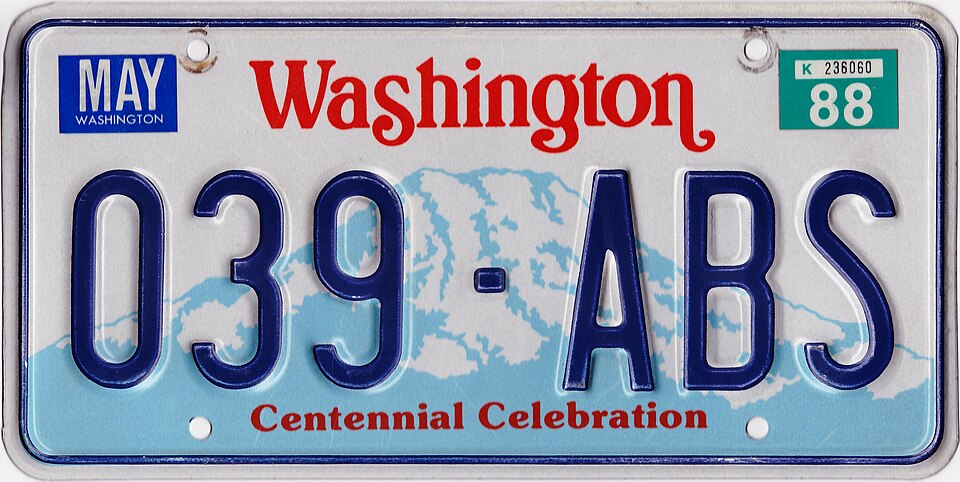
Sometimes the plate is fine and the tabs are not. Tabs are the small registration stickers applied to the plate. They peel off in heat, get scraped away in car washes, are sometimes stolen, and occasionally were never applied correctly. If only the tabs are missing or damaged, you are ordering replacement tabs rather than a plate. The plate number stays the same, the plate stays on the vehicle, and the registration itself does not change. You need your current registration information and identification, same as any replacement order. Replacement tabs are not a renewal. If your registration is current and the sticker is gone, you need tabs. If your registration has expired, you need to renew — see the Department of Licensing for deadlines and late fees.
What a replacement costs
Replacement fees vary depending on what you are replacing — one plate, a pair, tabs only, a personalized plate, or a specialty plate — and they change over time. Rather than quote a number that may be stale, confirm the current amount with a vehicle licensing office or the Department of Licensing, and ask whether the fee covers one plate or both. What does not change is the annual side. A personalized plate carries a $52 annual fee, a specialty plate carries $30 per year, and a personalized specialty plate carries $82 per year. Those charges are tied to the plate type and still apply at renewal; a replacement does not reset or waive them. For issuance costs and the differences between categories, see the Department of Licensing site.
How long does it take?
Turnaround depends on the method and on whether the plate must be manufactured. Standard plates are produced in batches, personalized plates are made to order with your characters, and specialty designs may follow a different production schedule. Online is the fastest order method because there is no postal transit in either direction. Ask what the plate replacement cost covers before you pay, since one plate and a pair differ. In person is fastest for the transaction itself, but the plate still arrives by mail rather than over the counter. Mail is slowest, since your request and your plate both travel through the postal system. Ask the Department of Licensing for current production and mailing timeframes, whether a temporary document is issued, and what you should display while you wait.
A missing front plate is still a replacement
Washington requires front and rear plates on most vehicles, so a missing front plate is a missing plate that needs replacing. Cars, SUVs, pickups, and vans all fall under the two-plate rule; motorcycles, trailers, mopeds, and collector vehicles are the frequent single-plate exceptions. The front plate is also the one most likely to disappear. It takes the brunt of road debris, gets lost in car washes and collisions, and is the plate people remove when they do not want to drill into a bumper. None of those reasons create an exemption. For the full rule and its exceptions, see the Department of Licensing site.
Personalized and specialty plates: what changes
Replacing a personalized plate is the same transaction as replacing a standard plate, with one important difference: your configuration is tied to your registration. You are not re-applying, and you are not re-entering a queue to see whether the characters are still available. You are replacing the physical plate that carries characters you already hold. The annual fee does not pause, though. A personalized plate carries $52 per year, a specialty plate $30, and a personalized specialty plate $82. A replacement is a one-time transaction on top of that annual charge, not a substitute for it. If the replacement is because the plate was stolen, tell the licensing office the configuration is already yours. If you want different characters, that is a different process — see personalized Washington license plates for applications, character rules, review, and the mail-only application process. Specialty holders should confirm the design is still produced. Washington offers roughly seventy special designs and occasionally retires one. If yours is no longer offered, the licensing office can cover your options and whether the annual fee structure changes.
Collector plates and the return rule
Collector plates follow different rules, and one matters here: collector plate holders must return their plates to a licensing office. That applies when the vehicle is sold, when the registration is cancelled, and when the plates are no longer in use. If you are replacing a lost or damaged collector plate, talk to a licensing office rather than ordering online. Collector registration has its own fees and eligibility rules, and since January 15, new requirements that include proof of ownership, proof of insurance, and a second registered daily-use vehicle. A replacement should not disturb any of that. See the collector plate page for details.
Stolen plates, tolls, and camera tickets
The cost of a stolen plate rarely stops at the replacement fee. Tolls, camera tickets, and parking notices can arrive weeks later, each one addressed to the registered owner rather than the driver who earned it.
Tolls and camera tickets
This is the part people underestimate. A stolen plate is not just metal; it is a working identifier someone else can attach to a vehicle and use to incur obligations in your name. Tolls. Good To Go! and the state’s toll facilities read plates. A vehicle running your stolen plate through the Tacoma Narrows or across SR 520 generates a bill that goes to the registered owner — you. Without a transponder, the plate is the only identifier, so the charge lands on your account. Camera tickets. Red light, school bus stop-arm, and speed cameras capture plate images. A citation issued against your plate number arrives at your address with your name on it, though you were nowhere near the intersection.
Parking, impound, and criminal exposure
Parking and impound. Parking enforcement and towing companies work from plates. A stolen plate on an abandoned vehicle can lead back to you. Criminal exposure. In the worst case, a vehicle displaying your stolen plate is involved in a collision or crime, and the first name in the investigation is the registered owner.
The defense is documentation
Report the theft, get the report number, order the replacement promptly so the old plate is superseded, and respond to every notice. When you dispute a toll or camera charge, include the report number, the theft date, the date you ordered the replacement, and the date the new plate was issued. That sequence proves the vehicle in the photo was not yours.
Update Good To Go! after the new plate arrives
If you use Good To Go!, update the new plate number on your account as soon as the replacement is installed. Your account is tied to specific plate numbers, and an outdated plate means your transponder and plate no longer match — which can produce a toll bill by mail instead of an automatic deduction. Log in, replace the old number with the new one, confirm the change saved, and keep the confirmation email.
What to do with the old plate
Washington’s rule is straightforward: when you dispose of a vehicle or stop using plates, return them to a vehicle licensing office. That covers more situations than people expect. You sold the vehicle. Remove the plates, return them, and file a Report of Sale. Filing the report is what protects you from tolls, tickets, and liability that accumulate after the buyer drives away. Returning the plates closes the loop on the plate itself. You traded it in. Same logic. The dealer may handle paperwork, but the plates are yours to return unless the dealer takes them, and the Report of Sale still matters. You moved out of state. Your Washington plates come off when you register elsewhere, and they should go back to a licensing office rather than into a drawer. You replaced a damaged plate. Ask whether the office wants the old one back. If it does, hand it over. If not, keep it until the new plate is mounted, then dispose of it so it cannot be reused.
Before you order: a short checklist
- Confirm whether the plate is lost, stolen, or damaged — and file a police report if stolen
- Write down the report number and store it somewhere durable
- Confirm the address on file is current, since the plate is mailed
- Decide whether you need a plate, a pair, or tabs only
- Note whether the plate is personalized or specialty, so the right annual fee applies
- Choose a method: online for speed, in person for complexity, mail if you are not rushed
- After installation, update Good To Go! and any parking or toll accounts tied to the old number
Frequently asked questions
The questions below cover the report, the order, the cost, and what happens to your characters after a replacement. Each answer points to the section that carries the detail.
Do I need a police report to replace a lost plate in Washington?
No. A lost plate is not a crime, and the replacement process does not require a report. A stolen plate is different: report it to police and keep the report number, which protects you from later toll charges and camera tickets.
Can I replace my Washington plates online?
Yes. Plate and tab replacement is available online through the Department of Licensing and License Express, and also by mail or at a licensing office. Online is usually fastest, but the plate still arrives by mail.
Does replacing a personalized plate cost me my characters?
No. Your characters are tied to your registration, so a replacement produces a new physical plate with the same configuration. You do not re-apply, and the $52 annual personalized plate fee still applies at renewal.
What if my stolen plate gets a toll charge?
Dispute the charge in writing within the deadline on the notice. Include the police report number, the theft date, the date you ordered the replacement, and the date the new plate was issued. Do not ignore the notice.
Do I have to return my old plates when I sell my car?
Yes. Washington requires plates to be returned to a vehicle licensing office when you dispose of a vehicle or stop using them. File a Report of Sale as well, and note that collector plate holders must return their plates too.