Washington License Plate tabs expire every year, and the month and year stickers on the rear plate show the deadline. Renewal runs online through License Express, by mail, or at a county licensing office. Fees vary with vehicle weight, county, and local transit charges, and custom plates carry their own annual charge on top. The Department of Licensing sends email reminders to owners who sign up for them, which helps avoid a late fee and a second trip. A missed date costs more than the renewal itself.
Washington License Plate renewal takes minutes online for most drivers. Enter the plate or registration number, confirm insurance, and pay. Stickers arrive by mail within days, and the old ones peel off with a little care. Late renewal brings penalties and, in some cases, a trip to the office. Personalized plate holders must renew within 45 days of their date or the state can cancel the plate and release the combination to another driver. Collector plates skip tabs altogether, a detail that surprises new owners who expect a yearly sticker.
How to renew Washington license plate tabs
Washington gives you three channels. They are not equally convenient for everyone, and the right one depends on whether your record is clean and whether you need to change anything at the same time.
Renew online through License Express
Online renewal is the fastest path when nothing about the record has changed. The flow below assumes the same vehicle, the same address, and the same plate.
- Go to the Department of Licensing’s online renewal service (License Express).
- Identify your vehicle using your plate number and the information the system asks for.
- Confirm your address and vehicle details are correct before you pay.
- Pay the amount shown for your vehicle and location.
- Keep the confirmation. Your new tabs arrive by mail; the confirmation is your proof in the meantime.
Two cautions about the online route. First, the amount the system quotes is the authoritative amount for your situation — any figure you read elsewhere, including on this page, is a category, not a quote. Second, online renewal generally assumes nothing needs to change. If you have moved, changed vehicles, or need to update a plate, handle that before or alongside the renewal rather than after.
Renew by mail
Mail renewal works well if you prefer paper, if you are paying by check, or if you are handling a renewal for a household member. The general flow: The full range sits side by side on the Washington license plates home page.
- Use the renewal notice mailed to you, or obtain the correct form from the Department of Licensing.
- Complete the vehicle and owner information exactly as it appears on your registration.
- Include payment for the full amount due. If the amount is unclear, confirm it before you mail anything.
- Mail it with enough lead time that it arrives before your expiration date. Mail does not pause your deadline.
- Keep a copy of everything you sent.
The mail route’s weakness is timing. If the plate itself is damaged, replace a plate rather than renewing the sticker. If you mail a renewal two days before expiration, you may be driving on expired tabs while your envelope is in transit. Renew early if you are using mail.
Renew in person at a licensing office
In-person renewal is the right choice when something is complicated. A counter can resolve an edge case that the online system cannot, and it can confirm the total before you pay.
- Your address or name has changed
- You need to update a plate or transfer registration
- Your tabs are lost or damaged and you need a replacement
- You are dealing with a title or ownership question
- You simply want the transaction finished and a person to confirm it
Bring identification, your current registration if you have it, and payment. Expect a wait at busy offices. In-person is slower but it resolves edge cases that online and mail cannot.
Official sources — Washington State DOL https://dol.wa.gov/vehicles-and-boats/vehicles/renew-or-replace-vehicle-tabs https://dol.wa.gov/appointments-and-locations
How Washington renewal works
Short answer: Washington registration is renewed every year. The month and year tab on your rear plate tells you when it expires, and you can renew online through License Express or the Department of Licensing, by mail, or in person at a vehicle licensing office. There is no single statewide renewal total — your amount depends on the vehicle, its weight, where you live, and local or regional transit fees. Plate-specific add-ons are separate: personalized plates carry an annual $52 fee, special background plates $30, and special background plates that are personalized $82. The part most people get wrong is not the renewal itself. It is the timing. Personalized plate holders have a hard 45-day window after their renewal date, and missing it can cost you the combination you have been paying for. That rule sits further down this page, but if you hold a personalized plate, read it before you do anything else.
Key Facts
| Item | Detail |
|---|---|
| Renewal frequency | Annually |
| Where expiration is shown | Month/year tab on the rear plate |
| Renew online | License Express / Department of Licensing |
| Renew by mail | Yes |
| Renew in person | Yes, at a vehicle licensing office |
| Total cost | Varies by vehicle, weight, location, and local/regional transit fees |
| Email reminders | Offered by the Department of Licensing |
| Personalized plate fee | $52 per year |
| Special background plate fee | $30 per year |
| Special background, personalized | $82 per year |
| Personalized plate grace period | 45 days from your renewal date |
| Collector vehicle plates | No month/year tabs required |
| Lost or damaged tabs | Separate replacement process |
When Your Tabs Actually Expire
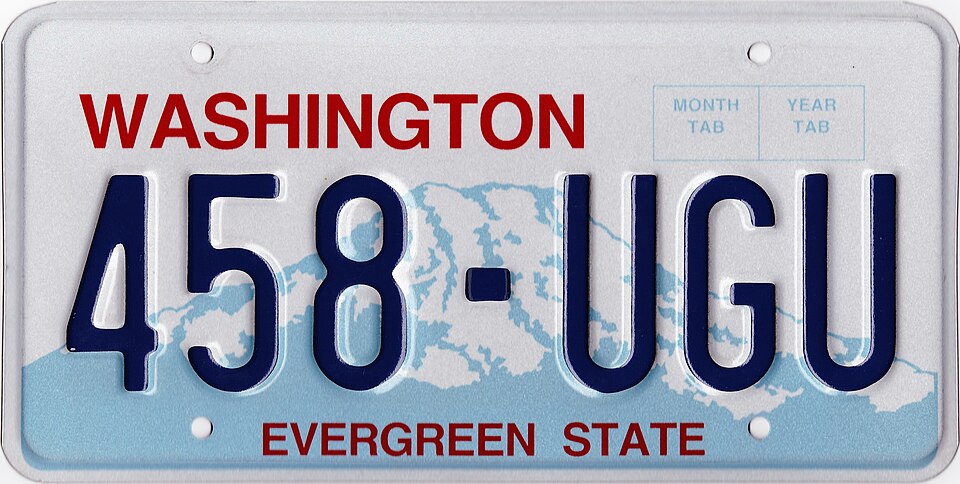
Your expiration date is printed on the tab affixed to your rear plate. Custom plates add annual renewal fees on top of registration, and those fees vary with weight and location. Not on your windshield, not in your head, and not on the front plate — Washington does not require a front plate, which is covered on the Department of Licensing site. Read the tab the way the state reads it:
- The month tab tells you which month your registration expires in.
- The year tab tells you which year.
Renewal runs on an annual cycle tied to your registration, not to the calendar year and not to the month you bought the car. That means your renewal month is yours personally — your neighbor’s renewal may fall in a completely different month. A few practical points about reading your own tabs:
- Look at the rear plate only. If you have been checking the front, you have been checking a plate that may not even exist on your vehicle.
- Look closely at stacked tabs. Tabs accumulate over the years as new ones are applied. The current tab is the newest one, and it can be partially covered by a frame or by older stickers.
- Do not remove old tabs. They are not the problem. If a tab is damaged or missing, that is a replacement issue, not a renewal issue.
- Write the date down. The single most effective renewal habit is putting the expiration date somewhere you will see it a month ahead of time.
If you cannot read your tab because it is damaged, missing, or obscured, do not guess. The replacement path is described in the Department of Licensing, and it is a different process from renewal.
What It Costs, and Why There Is No Single Number
Anyone who quotes a flat renewal figure is guessing. The total depends on the vehicle, its weight, the county you live in, and the local transit charges that apply to your address.
- Vehicle — the type and class of vehicle you are registering
- Weight — weight is a fee factor
- Location — where the vehicle is registered affects what local fees apply
- Local and regional transit fees — these vary by area and are added on top
Because those variables combine differently for every address and vehicle, the only reliable total is the one the Department of Licensing calculates for your specific registration. Get that number from the online system, your renewal notice, or an office. What you can plan for is the structure. Your total is essentially a base registration amount shaped by vehicle and weight, plus location-driven additions, plus any plate-specific annual fees you have opted into. The plate fees are the predictable part, so they are worth memorizing.
Plate Fees You Can Actually Pin Down
These are the published annual plate fees and they do not vary by county: Washington collector plates skip the tab cycle entirely, which changes the renewal picture.
| Plate type | Annual fee |
|---|---|
| Personalized plate | $52 |
| Special background plate | $30 |
| Special background plate, personalized | $82 |
Notice the arithmetic: $52 plus $30 equals $82. A special background plate that is also personalized carries both components, which is why it costs more than either alone. If you are comparing options, that relationship is the whole story. These fees renew with your tabs. They are not one-time charges and they are not billed separately on a different cycle. When you renew your registration, you renew the plate fee with it. For a wider view of what plates cost and how the categories break down, see the Department of Licensing site. If you are still deciding which plate type fits you, the Department of Licensing covers the differences in character rules and eligibility.
The 45-Day Rule for Personalized Plates
This is the rule that surprises people, and it is the reason personalized plate holders should treat renewal as urgent rather than routine. Personalized plate holders must renew within 45 days of their renewal date. If they do not, the Department of Licensing may cancel the plate and release the combination. Read that again with the consequence in mind. “Release the combination” means your chosen characters go back into the pool. Someone else can then request them. The plate you have held for years, the one with your name or your business or a meaning nobody else sees, becomes available to a stranger. What makes this rule sharp:
- It is shorter than most people assume. Forty-five days is about six weeks. A busy month, a lost notice, a vacation, and you are inside the window without realizing it.
- It applies to the plate, not just the registration. Ordinary registration lapses are one problem. Losing the combination is a separate, permanent-ish loss.
- Recovery is not guaranteed. If the combination has been released, you are competing for it like anyone else. Do not count on getting it back.
Practical defenses:
- Renew as soon as your renewal window opens, not on the last day.
- Turn on email reminders from the Department of Licensing so the date reaches you without effort.
- Put the date in your own calendar with a two-week warning in front of it.
- If you are traveling or unavailable around your renewal date, renew before you go.
- If something has gone wrong and you are near or past the 45 days, contact the Department of Licensing immediately rather than waiting for the next cycle.
If you have not yet applied for a personalized plate and are weighing whether the annual $52 is worth it, see that the fee buys you the combination — and the 45-day rule is the maintenance obligation attached to it.
Collector Plates and Tabs
Collector vehicle plates do not require month/year tabs. That is a real difference in how they are administered, and it changes the renewal picture. If you are used to standard plates, the absence of tabs on a collector plate looks like an expired registration. It is not. It is how the program works. This matters when you are:
- Reading someone else’s collector plate and wondering whether it is current
- Describing your own collector plate to an officer or a parking attendant
- Buying a collector vehicle and checking its paperwork
Collector plates have their own eligibility rules, use restrictions, and renewal requirements set by the program. Those are not the same as standard registration rules. See the Department of Licensing for the program details, and confirm anything specific to your vehicle with a licensing office.
Late Renewal: What Actually Happens
Washington requires vehicles on public roads to be currently registered. Driving on expired tabs puts you in violation, and the practical consequences stack up fast:
- Enforcement exposure. Expired tabs are visible from outside the vehicle, which makes them easy to notice. The specific penalty depends on the circumstances and where you are stopped.
- Compounding cost. The renewal does not get cheaper by waiting. You still owe the registration, and you may face additional consequences.
- Personalized plate loss. Past 45 days, the combination itself is at risk, which is a cost that money may not fix.
- Toll and parking trouble. Systems that read your plate expect current registration data. Stale records generate notices that take time to untangle.
- Administrative friction. A long lapse can complicate insurance, resale, and any transaction where a current registration is requested.
Do not plan around an assumed grace period. Treat the date on your tab as the real date. If you are already late, renew immediately rather than waiting for a notice — and if a personalized plate is involved, call the Department of Licensing the same day. The stages for getting plates in the first place, including the initial registration sequence, are on the Department of Licensing site.
Moving, Changing Vehicles, and Other Complication
Renewal gets messy when something else changed during the year. The right order is to fix the change first, then renew, because a stale record sends notices to the wrong place.
You moved
Update your address with the Department of Licensing. Your renewal notice and tabs go to the address on file, so a stale address means a missed notice and, potentially, expired tabs you did not know about. Your plate number is not tied to your county on current standard plates, so a move does not invalidate the characters. See the Department of Licensing for why county coding is not part of current plates.
You changed vehicles
Registration follows the vehicle. If you sold a vehicle and bought another, you are dealing with a new registration, not a renewal of the old one. Plate transfer rules depend on the plate type — personalized plates are tied to the holder, which is part of why they have their own rules.
You changed your plate
If your plate number changes for any reason, update your Good To Go! tolling account. An outdated plate on a tolling account is one of the most frequent sources of surprise toll bills, and it is entirely avoidable. Do this the same week your plate changes.
Your tabs were lost or damaged
Replacing tabs is a separate process from renewing registration. Do not renew in the hope that new tabs will fix a damaged sticker — and do not drive indefinitely on a missing tab.
Renewal Reminders
The Department of Licensing offers email reminders for tab renewal. Use them. They cost nothing, they arrive before the deadline, and they solve the single most frequent failure mode in the whole process, which is simply forgetting. Layer your reminders rather than relying on one:
- DOL email reminders — the official notice, sent to the address on your registration
- Your own calendar — a recurring annual entry, plus a two-week warning
- The paper notice — if you receive one by mail, do not throw it away unopened
- A physical cue — a note in the glovebox with the expiration month and year
If you have a personalized plate, set your personal reminder earlier than you think you need to. The 45-day window rewards people who act in week one, not week five.
Frequently asked questions
The questions below cover the cycle, the cost, and the 45-day rule that applies to personalized plates. Each answer is short and points to the section that carries the detail.
How often do I renew my Washington vehicle registration?
Annually. The month and year tab on your rear plate shows the expiration date. Renewal is tied to your registration cycle, not the calendar year, so your renewal month may differ from your neighbor’s.
How much does renewal cost?
There is no single statewide total. Registration fees vary by vehicle, weight, location, and local or regional transit fees. Get your exact amount from the Department of Licensing, your renewal notice, or a licensing office.
How much is the personalized plate fee?
$52 per year. It renews with your tabs and is charged on top of registration, so it is not a one-time charge. The special background and personalized specialty rates are in the table above.
What happens if I miss the 45-day window on a personalized plate?
The Department of Licensing may cancel the plate and release the combination, so someone else could request your characters. Contact the Department of Licensing immediately if you are near or past the 45-day deadline.
Do collector vehicle plates need tabs?
No. Collector vehicle plates do not require month or year tabs, and the absence of tabs is normal. It is not evidence of an expired registration, so do not assume the plate is out of date.