Washington License Plate personalization lets a driver choose one to seven characters. Washington personalized plates can sit on the standard mountain design or on an eligible specialty background. Letters, numbers, spaces, and dashes are allowed. Symbols are not. The state blocks dozens of letter and number patterns that clash with other series, including the three-letter, four-number shape used on standard issues. Applications go by mail to Olympia. Plates take eight to ten weeks. A plate may be rejected during final review even after the checker shows it as open.
Washington License Plate custom orders carry two charges: one at issuance and one at every renewal. A special background adds to the first figure. The renewal charge is the part many buyers miss until the first bill arrives. It applies with your tabs, and the state can cancel the plate after 45 days past the renewal date. Availability checks are free online. Approval is a separate test covering language and reserved patterns, so a denial can still land after payment.
How to apply for a Washington personalized plate
The application process has one surprising rule: vehicle licensing offices cannot process personalized plate applications. You cannot walk into your local office and order one.
Check availability
Use the DOL personalized plate checker before you do anything else. It tells you whether your combination is currently issued. Availability is not the same as approval — the checker does not test language rules or reserved patterns — but there is no point paying a fee for a plate that is already taken.
Choose your background and form
Standard mountain background plates use the standard personalized plate application form. Special design plates each have their own form, listed at the top of that design’s category page. Using the wrong form delays your application.
Confirm your registration is current
Your vehicle registration must be up to date before an application is processed. An expired registration is one of the quiet reasons an application stalls, and it is easy to check in advance.
Fill out the form legibly
This sounds trivial until it happens to you: if your handwriting cannot be read and the plate is manufactured incorrectly, you wait for a replacement. If the artwork matters more than the characters, compare special design plates before you settle on a combination. Print clearly, especially with letters and numbers that look alike.
Mail the form and payment
Send your completed application and payment to: Application and Issuance Unit
Department of Licensing
PO Box 9909
Olympia, WA 98507-8500 There is exactly one office in the state authorized to accept these applications in person: King County Records and Licensing Services
201 S Jackson St.
Seattle, WA 98104 If you are anywhere else in Washington, mail is your only option.
Wait for the plate to arrive
Personalized plates are manufactured to order and mailed to the address on your form. Eight to ten weeks is normal. There is no expedited option and no way to track the plate through production.
Official sources — Washington State DOL https://dol.wa.gov/vehicles-and-boats/vehicles/license-plates/personalized-plates https://dol.wa.gov/appointments-and-locations
Washington personalized plates key facts
| Item | Detail |
|---|---|
| Maximum characters | 7 on standard plates; 6 on motorcycles and small trailers |
| Allowed characters | Letters A-Z, numbers 0-9, spaces, and dashes |
| Issuance fee (passenger vehicle) | $174 personalized only · $162 special background only · $214 both |
| Annual renewal fee | $52 personalized · $30 special background · $82 both |
| How to apply | By mail only — vehicle licensing offices cannot process these |
| Processing time | 8 to 10 weeks |
| Availability check | Free online checker on the DOL website |
| Renewal deadline | Within 45 days of your renewal date, or the plate can be cancelled |
Rules for Washington personalized plates
Four rules decide whether an application succeeds: what counts as personalization, how many characters fit, which letter and number patterns the state blocks, and which language is rejected. The sections below take them in that order.
What counts as a personalized plate in Washington?
A personalized plate is a registration plate where the character sequence is chosen by the vehicle owner rather than assigned by the state. Owners of older vehicles should treat Washington collector plates as a separate route with its own rules. Washington calls them “personalized,” but the same product shows up in search results as custom plates, vanity plates, and personal plates. They are all the same thing, and they all follow the same rules. Two parts make up the plate: the background and the characters.
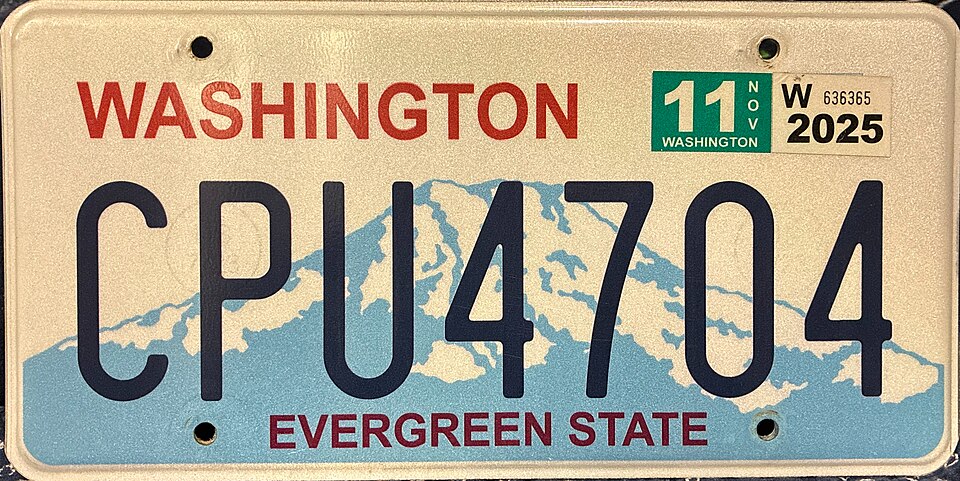
- Background: the standard Washington design (Mount Rainier with “Evergreen State” at the bottom) or one of roughly 70 special designs tied to organizations, causes, colleges, and sports teams.
- Characters: your chosen combination, subject to the limits below.
You can personalize a standard background, and you can personalize most special design backgrounds. Some cannot be personalized at all, and those are listed further down.
How many characters can you have?
The character limit depends on the vehicle class, and the allowed symbols are narrower than most drivers expect. The rules below apply to every personalized application, whatever background you choose.
- Letters A through Z (upper and lower case are treated the same)
- Numbers 0 through 9
- Spaces
- Dashes
You cannot use symbols such as &, @, !, #, +, or periods. A dash is the only punctuation allowed. You also choose the alignment of your characters: left, right, or centered. On plates where a design element sits on the left side — the U.S. Army plate is a good example — your characters align with the artwork rather than the plate edge.
The letter and number combinations Washington will not issue
This is where most applications fail, and almost no guide covers it properly. Washington reserves certain letter-and-number patterns because they would look identical to plates issued for other programs — amateur radio, military affiliate radio, colleges, and standard series plates. Before any application goes in the mail, check plate availability so you are not paying for a combination that is taken. If your chosen combination matches one of those patterns, it is rejected even if it is available as a phrase. The blocked patterns include:
| Pattern | Example |
|---|---|
| 1 letter + 4, 5, or 6 numbers | A1234 · B56789 · C123456 |
| 1 letter + 4 numbers + 1 letter | D1234E |
| 1 letter + 5 numbers + 1 letter | F12345G |
| 2 letters + 4 or 5 numbers | IN2006 · GR84112 |
| 3 letters + 3 or 4 numbers | ABC123 · ABC1234 |
| 1 number + 1 letter + 4 or 5 numbers | 1C2345 · 2L84123 |
| 1 number + 2 letters + 4 numbers | 1GR8345 |
| 1 number + 3 letters + 3 numbers | 4GET123 |
| 3 numbers + 3 letters | 123ABC |
| 4 numbers + 1, 2, or 3 letters | 1234U · 1234ME · 2008THS |
| 4 numbers + 1 letter + 1 number | 1234GO |
| 5 numbers + 1 or 2 letters | 12345A · 12345BY |
| 6 numbers, or 6 numbers + 1 letter | 123456 · 123456A |
| K, W, or N + numbers and letters (HAM pattern) | K1CK · W1NGS · KN0W |
| AA-AL + numbers and letters (MARS pattern) | AA2C · AF4JK · AL4FUN |
| College prefixes + 4 numbers | WSU1992 · UW1992 · GRN1992 |
Notice how ordinary some of these look. “ABC1234” is exactly the format Washington uses for standard-issue plates, which is why it can never be personalized. The same goes for a clean seven-character phrase like “123456A” — it looks unique to you, but it collides with a serial series. The practical takeaway: the safest personalized plates mix letters and numbers in a pattern that does not resemble a standard serial. “RUNVS” style all-letter combinations are rarely a problem; “ABC1234” style patterns almost always are.
Language rules and denials
Washington rejects personalized plate requests that contain inappropriate or offensive language, including profanity, sexual references, and terms that could reasonably be read as slurs or threats. The Department of Licensing reviews each application after submission, and a plate can still be denied during final review even if the online checker said the combination was available. The state denied more than 170 personalized plate requests in 2025 for language and content reasons. That number is worth sitting with: these are people who paid a fee and waited weeks, only to be refused. Two things follow from that:
- Availability and approval are different tests. A combination can be free and still be denied for content.
- If you are unsure whether a phrase crosses the line, it probably does. Pick something else before you mail the form.
Standard background vs special design background
Your choice of background changes the fee, the form, and in some cases whether personalization is allowed at all. The comparison below covers both routes before you commit to one.
| Background | What it is | Personalization | Extra fee |
|---|---|---|---|
| Standard mountain | The default Mount Rainier design with “Evergreen State” | Yes | None |
| Special design | Around 70 designs for organizations, causes, colleges, and teams | Most, but not all | $162 (or $214 combined with personalization) |
A portion of every special design plate fee goes to the organization or program the plate represents. That is the point of those plates: they raise money for the cause shown on them.
Special designs that cannot be personalized
Nine backgrounds do not accept custom characters, because the characters identify a program or a credential rather than a personal choice. The list below is the whole set.
- Medal of Honor
- Military Affiliate Radio System (MARS)
- Former Prisoner of War
- Disabled Veteran
- Horseless Carriage
- Restored
- Collector Vehicle
- Amateur Radio Operator (HAM)
- Exempt plates
If you want one of those, you get the design with the state-assigned characters and no personalization fee.
The prefix confusion
Special design plates often have letters or an image chosen by the organization. Those elements appear on standard plates in that series, but they do not carry over to a personalized version. If you personalize a Seahawks plate, for example, your plate will not automatically start with “SH.” The organization’s characters are part of the standard series, not part of your custom number. People order a personalized team plate expecting the team prefix and are disappointed when it arrives without it. Read the application form carefully before you commit.
What do Washington personalized plates cost?
There are two separate fees: one when the plate is issued and one every year after that. Most pages mention only the first, which is why the renewal figure surprises people at the counter.
Issuance fees (one time, paid with your application)
| Vehicle type | Personalized only | Special background only | Personalized + special background |
|---|---|---|---|
| Passenger vehicle | $174 | $162 | $214 |
| Truck | $174 | $162 | $214 |
| Trailer | $122 | $110 | $162 |
| Motorcycle | $92 | $80 | $132 |
The Keep Kids Safe plate adds $5 to whichever amount applies to you. These fees are in addition to your normal vehicle registration and tabs. Your total cost depends on the vehicle’s weight, location, and registration situation, so the plate fee alone is not your final bill.
Annual renewal fees
| Plate type | Yearly fee |
|---|---|
| Personalized plate | $52 |
| Special background plate (not personalized) | $30 |
| Special background plate that is personalized | $82 |
That $52 a year is the number that surprises people. Over five years, a $174 personalized plate actually costs $434 in plate fees alone, before registration.
How to avoid paying the fee twice
If your tabs are close to expiring, renew your registration and apply for the personalized plate at the same time. You will pay the personalized plate fee once. If you apply for the plate first and renew later, you pay the plate fee again at renewal. This is the single easiest way to save money on the process, and it is buried at the bottom of the DOL page.
What happens if your application is denied
Two things can go wrong: the combination is already taken, or it does not meet plate standards. If your application is denied, check the refund box on the form. That is the fastest route to getting your money back. If you leave it unchecked, the Department of Licensing holds your payment for 30 days and tries to contact you about an alternate plate; if they cannot reach you in that window, they refund the payment. Checking that box takes two seconds and saves weeks of waiting.
After your plate arrives: renewal, transfer, and cancellation
A personalized plate is not a one-time purchase. It carries obligations at renewal, at a sale, and at the toll account tied to the number, and missing one can cost you the combination.
Renew every year
You renew your personalized plate each year when you renew your vehicle tabs. The $52 annual fee applies. If you do not renew within 45 days of your renewal date, the state may cancel the plate and make your combination available to someone else.
Transfer within 30 days
If you sell, trade, gift, or otherwise stop owning the vehicle, you must transfer the plate within 30 days. Miss that window and you can lose the combination.
Update Good To Go
If you use a Good To Go! tolling pass, update your account with the new plate number after it arrives. Otherwise your tolls may be charged incorrectly or appear as violations.
Sign up for reminders
Washington offers tab renewal email reminders. For a plate you paid $174 for and renew every year, a reminder is cheap insurance against losing the combination to a missed deadline.
Personalized vs specialty vs collector plates
These three get confused constantly, and the confusion costs money because the products are not interchangeable. The table below separates what each one changes and what each one costs.
| Personalized | Specialty (special design) | Collector | |
|---|---|---|---|
| What it is | You choose the characters | A design tied to a cause or organization | A registration class for vehicles 30+ years old |
| Character choice | Yes, 1-7 | Only if the design allows personalization | No |
| Vehicle eligibility | Any registered vehicle | Any registered vehicle | Vehicle must be at least 30 years old |
| Extra requirements | None | None | Proof of ownership, insurance, and a second daily-use vehicle |
| Typical extra cost | $174 + $52/year | $162 + $30/year | One-time collector registration fee |
| Use restrictions | None | None | No regular transportation, no commercial use, no carrying a load |
The key distinction: personalized and specialty are cosmetic choices. Collector is a registration category with real restrictions on how you can use the vehicle. If you want a cool-looking plate for a daily driver, you want personalized or specialty. If you have a 1990s project car you drive occasionally, you want collector — and as of January, you need to prove you have another car for daily use. Full details on eligibility and the new documentation requirements are on the Department of Licensing site, and the design catalogue is there too.
Personalized plate ideas that actually get approved
The best-performing plates avoid the reserved patterns. All-letter combinations and letter-heavy phrases are the safest, because they do not resemble a state serial, and the examples below follow that rule.
Categories that work well
- Names and nicknames: first names, family names, and short nicknames fit comfortably in seven characters.
- Hobbies: climbing, fishing, hiking, cycling, and photography all shorten neatly.
- Local pride: references to Washington places, mountains, and waterways.
- Cars and trucks: model references and enthusiast shorthand.
- Short phrases: two-word combinations with a space or dash.
Examples of the format that clears the rules
- All letters, up to seven: EXPLORE, CASCADES, RAINIER, TIDEPOOL
- Two words with a dash: GO-WEST, SEA-TOWN
- Letters with one or two digits in a non-serial pattern: HIKE2, TRAIL7, SKY5
Notice what is missing: anything shaped like ABC1234 or 123456. Those look like plates, which is exactly why the state blocks them.
Mistakes to avoid that cost money and time
- Applying at a licensing office. They cannot process it. Mail or the King County office only.
- Not checking availability first. The checker is free and takes a minute; the fee is not refundable on demand.
- Choosing a reserved pattern. “ABC1234” style combinations are rejected automatically.
- Skipping the refund box. Leaves your money tied up for 30 days if you are denied.
- Applying before renewing tabs. You pay the plate fee twice.
- Expecting the design prefix. Personalized team plates do not keep the organization’s letters.
- Forgetting the annual fee. $52 a year, and the plate can be cancelled if you are late.
- Handwriting the form carelessly. A misread character means a replacement plate and another wait.
- Planning around a fast turnaround. Eight to ten weeks is normal, and there is no expedite.
- Not transferring within 30 days of selling the car. You can lose the combination permanently.
Frequently asked questions
The questions below cover timing, cost, denials, and what happens to your characters after a sale. Each answer points to the section that carries the detail.
How long does it take to get personalized plates in Washington?
Eight to ten weeks from the time your application is processed. The plates are manufactured to order after approval and mailed to the address on your form. There is no expedited service and no way to track the plate through production.
Can I order a personalized plate at a Washington licensing office?
No. Vehicle licensing offices cannot process these applications, so mail the form to the Department of Licensing in Olympia or apply in person at King County Records and Licensing Services in Seattle.
How much does a personalized plate cost per year?
A personalized plate renews at $52 a year. A special background renews lower, and a personalized specialty plate renews higher; the table above lists each rate. All of it is charged on top of your normal registration renewal.
Why was my personalized plate application denied?
The combination is already issued, it matches a reserved letter-and-number pattern, or it fails the language rules. Availability and approval are separate checks, so a plate the checker shows as open can still be denied during final review.
What happens if I sell my car with the personalized plate?
You must transfer the plate within 30 days of selling, trading, or gifting the vehicle. If you miss that window, the state may cancel the plate and release the combination to someone else.