Washington License Plate delivery follows vehicle registration, so how to get Washington license plates depends on how you acquired the car. A new resident has 30 days after establishing residency. A private sale gives the buyer 15 days. Dealers file the paperwork for cars bought on their lot. The county licensing office or a mail submission handles the rest. You need a title, photo identification, odometer reading, insurance proof, and payment. Plates arrive by mail later, and temporary permits cover the gap.
Washington License Plate paperwork shifts with the purchase type. A dealer sale arrives with the title work started. A private sale needs a signed title, a bill of sale, and an odometer statement. An out-of-state move may add a VIN inspection. Gifts and inheritances need their own forms. Fee totals vary by weight, county, and local transit charges, so no single price covers every car. A licensing office can quote the exact figure before you pay, and a short call saves a second trip.
How to get Washington license plates: four paths
The path depends on how you acquired the vehicle. A dealer sale, a private purchase, a move from another state, and a gift or inheritance each carry different paperwork and different deadlines. The four sections below follow the same order: what you need, where to file, and how long you have.
Buying from a dealer
- Negotiate and sign. The dealer prepares a buyer’s order, title application, and odometer disclosure.
- Provide your documents. Photo ID, insurance information, and payment for fees and taxes.
- Dealer submits the paperwork. They handle the title transfer and registration with the state.
- Drive on the temporary permit. Dealers issue a temporary tag that covers the gap until plates arrive.
- Receive plates by mail. They go to the address on the registration, so confirm the dealer recorded it correctly.
The one thing to verify: that the dealer actually submitted the registration. Occasionally paperwork sits. If three weeks pass with no plates and no update, call the dealer’s title clerk and ask for the date of submission.
Buying from a private seller
- Inspect the title before money changes hands. Confirm the seller’s name matches their ID, there are no unresolved liens, and the buyer section is blank.
- Complete the title transfer. Both parties sign where indicated. Fill in the sale date, price, and odometer.
- Write a bill of sale. Not always required, but it protects you if the title is later questioned. Include date, price, VIN, and both names.
- Get insurance on the vehicle before you drive it.
- Visit a licensing office within 15 days. Bring the signed title, your ID, the odometer reading, insurance, and payment.
- Pay fees and taxes. You will owe registration fees plus use tax on the purchase price.
- Wait for plates by mail. Ask the counter whether a temporary permit is available if your old plates are invalid.
Keep the seller’s plates off the car unless the office tells you otherwise. The full range sits side by side on the Washington license plates home page. Plates generally follow the seller, not the vehicle, in a private sale.
Moving from out of state
- Gather your out-of-state title. If a lender holds it, get a copy or a lienholder statement.
- Get Washington insurance. Washington minimums apply once you are a resident.
- Expect a VIN inspection. Out-of-state vehicles often need one. It verifies the VIN on the vehicle matches the paperwork and is not a salvage or stolen unit. Some licensing offices perform these on site; others use a designated inspection location.
- Register within 30 days of establishing residency.
- Surrender or keep your old plates according to your prior state’s rules. Some states require you to return them.
- Receive Washington plates by mail.
Two things catch new residents here. First, the front plate requirement. Washington issues two plates for most vehicles, and you are expected to display both. Second, emissions testing. Washington registration fees vary by weight, county and local charges, so no single total applies. Not every county requires it, and the requirement is tied to where the vehicle is registered, not where you bought it. Confirm with the Department of Licensing or your county before you assume you are exempt.
Receiving a gift or inheritance
- Confirm how the vehicle is being transferred. A gift from a living owner uses a gift title transfer. An inheritance may go through probate or through a transfer to a surviving family member.
- Get the title in the correct name. If the estate holds the title, the personal representative signs. If the title is already in the deceased owner’s name and there is no estate, ask the licensing office what documentation they will accept before you go.
- Complete the gift or transfer affidavit that applies to your situation.
- Register within 15 days of receiving the vehicle.
- Pay the fees that still apply. A gift may change the tax calculation, but it does not eliminate registration fees.
Inheritance cases vary enormously depending on whether there was a will, whether probate was opened, and whether the vehicle was jointly owned. Do not guess. Call the licensing office with the specifics and ask exactly which documents they want.
Official sources — Washington State DOL https://dol.wa.gov/vehicles-and-boats/vehicles/vehicle-registration https://dol.wa.gov/moving-washington https://dol.wa.gov/appointments-and-locations
Washington vehicle registration key facts
| Item | Detail |
|---|---|
| Where to register | County-run vehicle licensing office, or by mail to the Department of Licensing |
| Deadline after moving to Washington | 30 days of establishing residency |
| Deadline after a private sale or gift | 15 days |
| Dealer purchases | The dealer handles registration and title work for you |
| Core documents | Proof of ownership, photo ID, odometer reading, proof of insurance, payment |
| Extra stage for out-of-state vehicles | VIN inspection may be required |
| Plates required | Front and rear on most vehicles; one rear plate on motorcycles, trailers, campers, mopeds, collector vehicles, and horseless carriages |
| How plates arrive | By mail after registration; temporary permits cover some situations |
| Renewal cycle | Annual, with tabs |
| Cost | Varies by vehicle type, weight, location, county, and local fees; there is no single flat price |
Who needs to register, and by when
Washington requires registration for any vehicle operated on public roads. That includes cars, trucks, motorcycles, motor homes, trailers, and mopeds. Off-road-only vehicles follow a separate process and do not get standard road plates. The deadline depends on how the vehicle arrived in your life.
Moving to Washington
New residents have 30 days from the date they establish residency to register their vehicles. Establishing residency is not always the same as the day you signed a lease. It can be triggered by things like registering to vote, claiming a resident tuition rate, or getting a Washington driver license. If you are unsure which date applies to you, confirm with the Department of Licensing or a vehicle licensing office before the window closes. Do not wait for the 30th day. Offices in densely populated counties book out, and mail processing adds days on top. A vehicle with expired out-of-state registration sitting in a driveway for a month is a good way to collect a citation you did not need.
Buying from a private seller
You have 15 days from the date of sale to transfer the title and register. New residents are often surprised that front and rear plates are both required. The clock starts on the date written on the title, not the date you get around to it. If the seller left that field blank, fill it in accurately and keep a copy of the bill of sale.
Receiving a vehicle as a gift
Gifts also run on the 15-day clock. Washington has a specific title transfer process for gifted vehicles, and the paperwork differs from a sale. See the gift and inheritance section below.
Buying from a dealer
You do not have to visit a licensing office. Washington dealers are required to handle the title and registration paperwork as part of the sale, and they collect the fees. Your job is to provide identification, insurance information, and payment, then wait for the plates.
Leasing
The leasing company is typically the registered owner and handles registration. You still need to make sure the vehicle has valid plates and tabs, and you should confirm who pays the annual renewal. Read that clause before you sign.
Documents you need
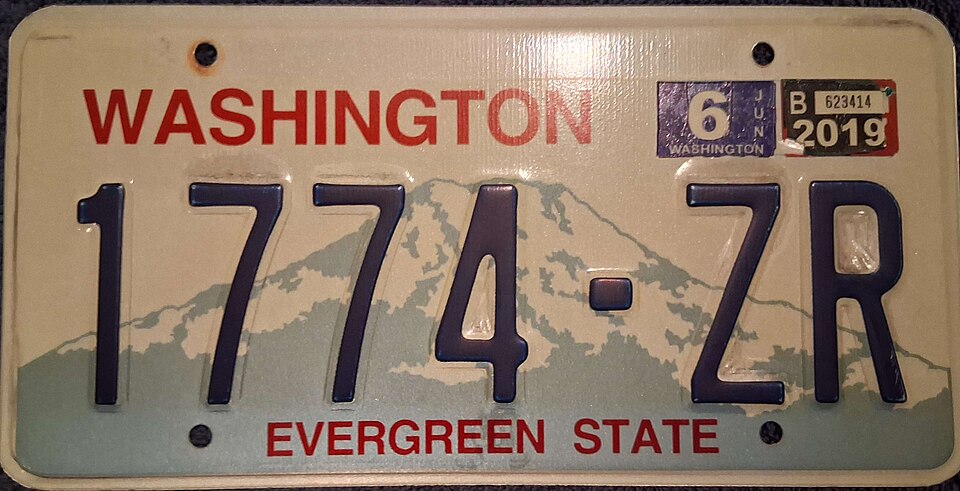
The list is short, but each item has conditions that trip people up. The Washington plate format tells you what the characters should look like when they arrive. Bring originals, not photos on your phone.
| Document | What counts | Frequent problem |
|---|---|---|
| Proof of ownership | A title in your name, or a title signed over to you by the seller | Seller signed in the wrong section, or the buyer name is missing |
| Photo ID | Washington driver license or ID card; out-of-state ID is usually accepted | Expired ID, or a name that does not match the title |
| Odometer reading | Stated on the title or on a separate odometer disclosure | Blank odometer field on an older title |
| Proof of insurance | Current insurance card or declaration page for the vehicle | Policy still lists the previous vehicle |
| Payment | Cash, check, card, or money order depending on the office | Assuming every office takes every payment type |
| VIN inspection | Required in some out-of-state and reconstructed-vehicle situations | Not knowing it was needed until you reach the counter |
Proof of ownership details
If you bought the vehicle, the seller must sign the title over to you and hand over the original. A bill of sale alone is not proof of ownership in Washington. If the title is lost, the seller needs to request a replacement before the sale, and that adds days to a 15-day deadline. If there is a lien on the vehicle, the lender may hold the title. The licensing office can work with a lien release or a title held electronically, but you should ask about the specific situation rather than assume.
Odometer rules
Federal odometer disclosure applies to most vehicles. The seller states the mileage and certifies whether it is accurate. If the vehicle is exempt because of age, the field may be marked exempt instead. Either way, do not leave it blank, because a blank odometer field is one of the most frequent reasons a title transaction gets sent back.
Insurance timing
Washington requires liability insurance on registered vehicles. You need coverage in place at the time of registration, not after. If you are switching insurers, get the new policy to start on or before the registration date so there is no gap.
Why the fees are different every time
There is no flat price for registering a vehicle in Washington, and any website that quotes one number is wrong or is quoting a single county on a single vehicle type. Registration fees are built from several layers:
- Vehicle type. A motorcycle, a passenger car, a heavy truck, and a trailer are all assessed differently.
- Weight. Trucks and larger vehicles pay based on weight, so the same model can cost different amounts depending on configuration.
- County. Counties add their own fees, and they differ from each other.
- Regional transit. Vehicles registered in certain areas pay a regional transit fee.
- Local levies. Some cities and transportation benefit districts add fees.
- Vehicle-specific charges. Electric vehicles, plug-in hybrids, and other categories may carry additional charges.
- Tax on the transaction. A purchase involves use tax on the price paid, which has nothing to do with the plate itself.
That is why the same 2018 pickup can cost one amount in one county and a different amount 40 miles away. It is also why the only reliable estimate comes from the licensing office that will process your transaction, using your VIN and address. The Department of Licensing breaks down the plate-specific fees, but it deliberately does not quote a single registration total, because that total does not exist.
When the plates arrive
Standard plates are produced after registration and mailed to the address on your record. They do not come off a stack at the counter. That means there is always a gap between paying and driving with metal on the car.
Temporary permits
Temporary permits exist to cover that gap in certain situations, most frequently dealer sales and some private transactions. A permit is printed and displayed in the rear window or a specified location. It has an expiration date, and driving past it is the same as driving unregistered. Ask at the counter whether you are getting a permit and when it expires. If the permit is shorter than the plate production window, you may need to follow up for an extension. Do not assume the office will call you.
What to do if plates are late
- Check the mailing address on your registration document. A transposed apartment number sends plates back to the state.
- Wait out the normal production window. Standard plates are usually faster than custom plates, which take considerably longer.
- Call the licensing office where you registered. They can see whether the order was processed.
- Ask about a replacement or a new permit if the delay runs past your temporary authority.
If your plates were issued but never arrived, that is a replacement situation rather than a registration problem. Replacing lost or damaged plates is a separate process from registration.
Choosing a plate design
When you register, you can usually choose among four groups. The differences come down to cost, character rules, and whether the design is tied to a cause or an organisation.
- Standard plates with the mountain design, at no extra plate fee beyond registration.
- Specialty plates tied to a cause, college, or organization, which carry an additional issuance fee and an annual renewal fee.
- Personalized plates, where you choose the characters, with their own issuance and annual fees.
- Collector plates for qualifying older vehicles, which are a registration category rather than just a design.
Two practical notes. First, specialty and personalized plates are made to order, so the wait is longer than for standard plates. Second, if you want a personalized plate, applying at the same time as registration and renewal avoids paying the issuance fee twice. The Department of Licensing covers what combinations the state will actually issue.
Front and rear plates: the rule new residents miss
Washington requires both a front and a rear plate on most vehicles. This is not universal in the United States, which is why people arriving from one-plate states get pulled over in their first month. One rear plate is issued for:
- Motorcycles
- Trailers
- Campers
- Mopeds
- Collector vehicles
- Horseless carriages
If you were issued two plates, mount both. Putting the front plate in the glovebox because it spoils the look of the bumper is a fix-it ticket waiting to happen. Our guide to the Department of Licensing covers mounting options and the exceptions in detail.
Delays and how to avoid them
| Delay | Cause | Fix |
|---|---|---|
| Title rejected at the counter | Missing signature, wrong section, buyer name absent | Contact the seller before the 15-day window closes |
| Name mismatch | ID shows a married or shortened name the title does not | Bring supporting documentation or correct the record first |
| No insurance on file | Policy starts after the appointment | Move the policy start date earlier |
| VIN inspection required | Out-of-state or reconstructed vehicle | Ask when booking whether the office performs inspections |
| Plates never arrive | Wrong address on the record | Verify the address on your registration document |
| Odometer field blank | Seller skipped it | Complete a separate disclosure before submitting |
| Appointment backlog | Popular county offices | Book early or check neighboring county offices |
After the plates are on
Registration does not end when the plates arrive. Three follow-up tasks keep the record clean, and skipping them is how a simple registration turns into a second visit.
- Update your insurer with the plate number. Some policies rate on the vehicle, but the plate is how claims and tolls get matched.
- Update Good To Go! if you use a toll transponder or a pay-by-plate account. Old plate numbers on an account generate bills for someone else.
- Check your registration address. Renewal reminders and plates both go there.
- Note the renewal month. Renewal is annual, and tabs are the visible proof. Late renewal means expired tabs, which is an easy ticket.
- Keep the registration in the vehicle. Washington does not require you to display registration, but you should be able to produce it.
Renewal itself is straightforward: it can be done online, by mail, or in person, and the fee is the same base registration plus whatever plate fees apply. Renewal timing rules matter here: lapse and your tabs expire even though your plates are still valid.
Frequently asked questions
The questions below cover deadlines, documents, and the delays that slow a registration down. Each answer points to the office or the page that carries the detail.
How long do I have to register a car after buying it in Washington?
Fifteen days from the date of a private sale or gift. The clock starts on the date written on the title. Dealer sales are handled by the dealer, so the paperwork timeline is on them rather than you.
Can I register my vehicle by mail?
Yes, mail registration is available through the Department of Licensing for many transactions. It is slower than an in-person visit, and any error in the packet adds another round trip. If you are near a deadline, go in person.
Do I need a VIN inspection?
Often, for vehicles coming from another state, and in some reconstructed or specially titled situations. Not every licensing office performs inspections, so ask when you book rather than making two trips.
Will I get plates the same day?
Usually not. Standard plates are produced after registration and mailed to the address on your record. Temporary permits cover some situations while you wait, so ask at the counter whether one applies.
Do I need a front plate in Washington?
Yes, on most vehicles. Motorcycles, trailers, campers, mopeds, collector vehicles, and horseless carriages get one rear plate instead. If you were issued two plates, mount both, because a front plate left in the glovebox is an easy fix-it ticket.