Washington License Plate buyers who want an all-black design can order the Washington black license plate, a throwback with white characters on a black background. The state released it in November 2025, drawing on an early 1900s Washington issue. The surface is flat rather than embossed. It counts as a special design, so the standard mountain rules do not apply. Ordering runs through the Department of Licensing or a licensing office. Plates ship by mail after production, with a wait measured in weeks.
Washington License Plate buyers who want an all-black design can order the throwback, a special design with white characters on a black background. The state released it in November 2025, drawing on an early 1900s Washington issue. The surface is flat rather than embossed, and it counts as a special design rather than a standard one. Some drivers confuse it with a black-and-yellow plate, a historical issue from the 1918 to 1920 period that is not a current product. Ordering runs through the Department of Licensing.
How to get a Washington black license plate
Ordering runs through the Department of Licensing or a vehicle licensing office. There is no separate boutique or third-party channel, and you should be skeptical of any site that claims to sell you a Washington plate directly. A practical sequence looks like this.
- Confirm your vehicle’s eligibility and current registration status. Plates attach to a registered vehicle, so registration problems come first.
- Decide whether you want the plain black background or a personalized version. This determines which fee applies, so decide before you submit anything.
- If personalizing, prepare a few character options. Have backups ready in case your first choice is taken or rejected.
- Submit the order through DOL or a licensing office. Ask what the total will be, including registration if it is due at the same time.
- Confirm what happens to your current plates. Ask specifically whether they need to be returned, and get the answer in writing if you can.
- Wait for the plate, then mount it. Follow the standard mounting rules for front and rear plates on your vehicle type.
The fifth point is the one people skip. Washington’s rules on returning old plates depend on the situation, and the answer is not the same for every transaction. Rather than guess, ask the person processing your order, and ask them to confirm with DOL if they are unsure. The full range sits side by side on the Washington license plates home page. The sixth point matters more than it sounds. Washington requires plates to be displayed according to the rules for your vehicle, and a new plate does not change that. If you are unsure how many plates your vehicle needs or where they go, check the rules before you drill anything.
Official sources — Washington State DOL https://dol.wa.gov/vehicles-and-boats/license-plates/get-custom-plates/special-design-plates/throwback-plate https://dol.wa.gov/vehicles-and-boats/vehicles/license-plates/special-design-plates
Key facts
| Item | Detail |
|---|---|
| Plate name | Black “throwback” special design plate (white characters on black) |
| First available | November 2025 |
| Plate type | Special design plate, not a standard issue plate |
| Design source | Based on an early-1900s Washington plate |
| Surface | Flat, not embossed like older plates |
| Personalizable | Yes. It is not on DOL’s non-personalizable list |
| Fee, passenger car or truck (background only) | $162 |
| Fee, passenger car or truck, personalized | $214 |
| Fee, trailer (background only / personalized) | $110 / $162 |
| Fee, motorcycle (background only / personalized) | $80 / $132 |
| Renewal | Annual special-design renewal fee applies; confirm the current amount with DOL |
| Where to order | Department of Licensing or a vehicle licensing office |
| Replaces the standard plate? | No. The Mount Rainier standard plate remains the default |
What the Washington black license plate actually is
The throwback is easier to understand once it sits in the right category, because most confusion about it comes from the bucket rather than the design. It shares a family with other special design plates, and it is not a registration category of its own.
Which group the throwback belongs to
Start with the category, because most of the confusion comes from putting the plate in the wrong bucket. Washington issues several kinds of plates. There is the standard plate that every passenger vehicle gets by default. There are collector vehicle plates. There are specialty plates tied to organizations, causes, colleges, and military service. And there are special design plates, which are the group the black throwback belongs to. A special design plate is a plate you choose and pay extra for. It replaces the look of your plate but not the legal status of your registration. Your vehicle is registered exactly the same way. Your tabs, your renewal cycle, your insurance requirements, and your driving record do not change because of the background art. What changes is what the plate looks like and how much you paid for the privilege. The throwback sits in the same family as Washington specialty plates, which is why the fee table looks familiar.
What the design looks like
The black throwback’s design is deliberately plain: white characters on a black field, with no mountain, no scenery, and no gradient. That restraint is the point. It reads as an old plate because old plates were mostly text on a solid color. The design traces back to an early-1900s Washington plate, which is why the word “throwback” stuck to it in frequent use.
The plate is flat, not embossed
One physical detail matters more than people expect: the plate is flat. It is not embossed the way older Washington plates were, where each character was stamped into the metal and stood up from the surface. A flat plate is produced differently, with the design and characters printed as part of the plate face. If you are picturing the raised, stamped look of an old plate, the black plate will not match that memory.
What the plate is not
It is also worth being clear about what the plate is not. It is not a reissue of an antique plate, not a vintage plate program, and not a restricted-use plate for old vehicles. Those are separate things. Washington has collector vehicle plates for that purpose, and they follow their own rules. The black throwback is a modern, fully legal, everyday plate that happens to look old.
Why Washington issued a throwback design
Special design plates usually carry a message from an organisation or a cause. This one carries a different kind of signal: taste rather than membership. That difference explains why it stands out in a lineup built mostly around affiliations.
Why this design exists
Special design plates exist because people want their plate to say something. Usually that something is an affiliation: a college, a team, a cause, a branch of service, a park. The black throwback says something different. It signals taste rather than membership. There is no organization behind it and no cause attached to it. It is a design choice. That puts it in an unusual spot in Washington’s lineup. Most special design plates are requested by a sponsoring organization and tied to that group’s identity. A throwback design is closer to a style option, which is probably why it drew attention fast. Drivers who find the standard mountain artwork busy, or who want a plate that does not look like every other car in the lot, get a clean alternative without leaving the special design system.
The moratorium limits new designs
The counterweight is volume. Washington has roughly 70 special design plates, and a moratorium on adding new designs has been in place. That moratorium is the reason a genuinely new design is notable when one does appear. If you are waiting for a specific design idea to be added, do not assume it will be. Confirm with the Department of Licensing before you plan around a plate that does not exist yet.
White-on-black vs. black-and-yellow: clearing up the real confusion
This is the single most frequent mix-up, so it deserves a straight answer. Washington’s new throwback plate is white lettering on a black background. It is not black lettering on a yellow background. If you have seen photos of a black plate with yellow characters and assumed that was the new release, you were looking at something else. A genuine black-and-yellow Washington plate is a historical issue from the 1918-1920 era. Those plates were actually made and actually used, roughly a century ago. They are collectibles now, not a product you can order. No current Washington plate program issues a black-and-yellow plate for everyday registration. If someone offers to sell you a “new” black-and-yellow Washington plate, that is a red flag. There are two honest reasons people search for “black and yellow Washington plate” and land on the wrong answer.
- Memory of the old design. Someone saw a restored antique vehicle, a museum display, or a photograph of an early Washington plate and remembered the black-and-yellow scheme. That memory is accurate, but it describes history, not a current option.
- Confusion with specialty designs. Washington’s roughly 70 special design plates use a wide range of color schemes, and some are dark with light characters. A short look at a moving car can turn a dark specialty plate into “black and yellow” in memory.
Here is the comparison in plain terms.
| Black throwback (current) | Black-and-yellow (historical) | |
|---|---|---|
| Status | Available special design plate, launched November 2025 | Historical issue from the 1918-1920 era |
| Colors | White characters on black | Black characters on yellow |
| Can you order it? | Yes, through DOL or a licensing office | No. Not a current product |
| Can you drive on it? | Yes, as a registered special design plate | Only under whatever rules apply to antique and collector vehicles, which you should confirm with DOL |
| Typical owner | Any registered passenger vehicle | Collectors and historical displays |
The short version: if you want the new plate, ask for the black throwback with white characters. Adding custom characters means following the personalized character rules and filing the matching form. If you want the old look, you are shopping for a historical artifact, not a plate from the state. Those are different transactions with different rules, and mixing them up is how people end up disappointed.
What the Washington black license plate costs
Fees are where people get surprised, because the special design fee is not the whole bill. The amounts below come from the DOL’s published fee table for special design plates. They are charged in addition to normal registration and tabs. In other words, you still pay whatever your registration costs, and the plate fee sits on top of it.
| Vehicle type | Special background only | Personalized + special background |
|---|---|---|
| Passenger car or truck | $162 | $214 |
| Trailer | $110 | $162 |
| Motorcycle | $80 | $132 |
The table lists plate charges, not a final bill, and two numbers matter most. The gap between the plain background and the personalized version is the cost of adding characters. Vehicle class moves both figures lower for trailers and motorcycles.
Reading the fee table
Read the table as a menu of plate charges, not a total. A passenger car owner choosing the plain black background pays $162 for the plate plus normal registration. The same owner choosing a personalized black plate pays $214 plus normal registration. The difference between those two numbers, $52, is the cost of adding personalization to this particular design. Trailers and motorcycles sit lower on the scale, which is consistent with how Washington prices most plate products. A personalized motorcycle plate at $132 is the cheapest way into a personalized black plate.
Confirm the amount before you budget
Fees change. The numbers above reflect the published DOL table, but plate pricing is set administratively and can be updated. Before you budget, confirm the current amount with a vehicle licensing office or the Department of Licensing. That single check prevents most billing surprises, and it is worth doing if you are ordering several plates or combining a new plate with a registration renewal. One more note that catches people: the special design fee is a plate fee, not a registration fee. It does not reduce your registration, and it does not replace your tabs. If your registration is due, you are paying both. For a broader breakdown of what plates cost in Washington, see the Department of Licensing site.
Can you personalize the black plate?
Yes. The black throwback is not on the DOL’s list of non-personalizable designs, which means you can combine it with a personalized character sequence. Washington personalized plates run 1 to 7 characters, and the same content rules apply regardless of which background you pick. That combination is the $214 option for a passenger car or truck, $162 for a trailer, and $132 for a motorcycle. You are paying for two things at once: the special background and the personalized characters. Personalization is where orders get rejected, so plan for it. The state reviews character combinations and can decline anything it considers offensive, misleading, or otherwise improper. It can also decline combinations that conflict with existing plate formats or that read as an official designation. You will not get a detailed appeal process description at the counter, so the practical approach is simple: submit something unambiguous, and have alternatives ready.
- Keep it short. Fewer characters means fewer ways to misread it.
- Avoid combinations that look like a government or military designation.
- Avoid anything that could be read as a slur, a threat, or a drug reference.
- Skip spacing tricks that only work if the reader guesses your intent.
- Check that it still reads the way you want at plate size, not on a screen.
If personalization is the main reason you want this plate, read the Department of Licensing for the full set of rules before you order. It covers character limits, review, and renewal, all of which apply to the black throwback just as they apply to the standard mountain plate. Compare the Washington plate cost against registration before you order, because the two are billed separately. If you are not personalizing, you get an assigned combination in the state’s normal sequence. That is the cheaper path and the faster one, since there is no content review on your characters.
Is it legal, and can you keep your old plate?
Legality and the fate of your old plate are two separate questions, and both tend to arrive in the same conversation. The first is settled: the state issues the design. The second depends on what you were running before.
Is the black plate legal?
The plate is fully legal. It is issued by the state, it is a recognized special design, and there is nothing about a black background that affects your registration. You are not taking a risk by driving on it, and you are not creating a problem at a traffic stop. It is a state-issued plate exactly like any other special design, and the flat construction is a production method rather than a legal category.
What happens to your old plate
The old-plate question is separate and depends on your situation. When you move to a new special design plate, what happens to the plate you were running depends on whether it was a standard plate, a personalized plate, or another special design, and on whether the state wants it back. Some plates must be returned, some can be kept, and some are surrendered at the counter as part of the transaction. Two things are consistently true. First, you cannot run two sets of plates on one vehicle. Second, the plate on the vehicle must match the registration. So even if you are allowed to keep an old plate as a souvenir, it does not go back on the car while the new one is registered. Ask the licensing office what applies to your plates, and confirm with DOL if the answer is unclear.
Timeline: from decision to bumper
The plate became available in November 2025, so the ordering window is open and there is no wait-for-launch stage. What remains is production and delivery. Special design plates are not sitting in a drawer at every licensing office, which means there is a gap between paying and mounting. The only stage with real uncertainty is the production window, and the only responsible answer is to ask. Timelines shift with order volume and production capacity, and a number you read online is not a commitment. If your registration is due soon, order early enough that you are not driving on expired tabs while waiting for a plate. Registration and plate production are separate clocks.
Black throwback vs. the standard mountain plate
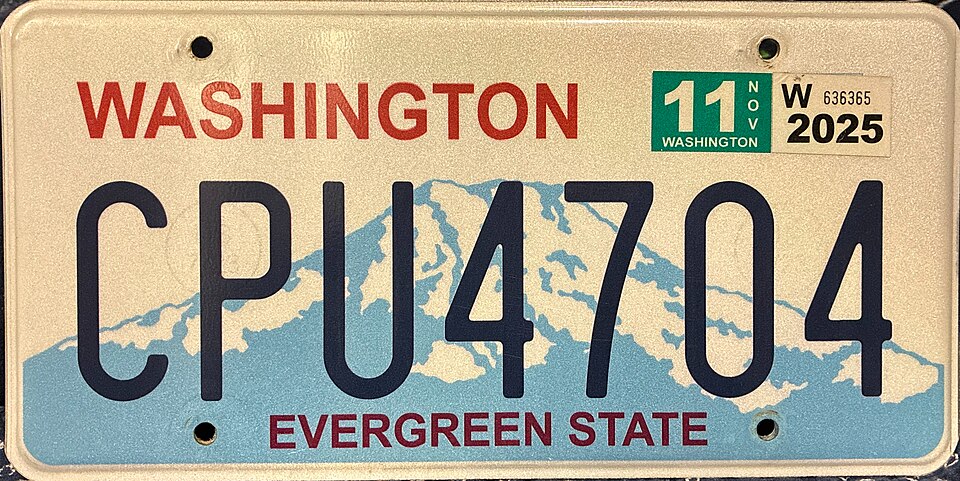
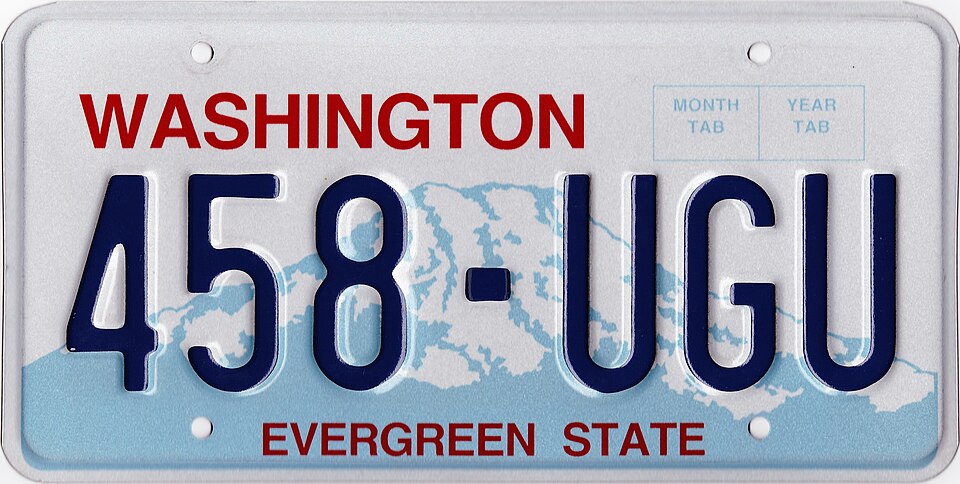
The standard plate is the Mount Rainier design: mountain artwork, “Evergreen State” across the bottom, introduced in July 1998. It is the default. You do not order it, you do not pay extra for it, and it comes with the vehicle. It is also the plate most Washington vehicles are wearing right now.
| Black throwback | Standard Mount Rainier plate | |
|---|---|---|
| Design | White characters on solid black | Mountain artwork with “Evergreen State” |
| Status | Optional special design | Default standard issue |
| Extra plate fee | $162 passenger/truck, $214 personalized | None |
| Personalizable | Yes | Yes |
| Annual renewal impact | Special-design renewal fee applies | Standard renewal only |
| Best for | Drivers who want a minimal, vintage look | Drivers who want no extra cost |
The choice comes down to money versus look. The standard plate is free and perfectly serviceable. The black plate costs a real amount up front and adds an annual renewal charge, and what you get in return is a design that stands out without being loud. If you want your plate to support something specific rather than just look a certain way, browse the Department of Licensing first. The fee structure is comparable, so the decision is mostly about what you want the plate to say.
Mistakes to avoid
Most problems with this plate come from three habits: ordering before checking availability, assuming the design changes registration, and expecting a fast turnaround. Each one is avoidable, and each costs either time or money.
- Expecting yellow characters. The plate is white on black. The black-and-yellow look is a 1918-1920 historical issue, not the current product.
- Assuming it is the new standard plate. It is not. You have to order it and pay for it, and the mountain plate remains the default.
- Budgeting only the plate fee. Registration and tabs are separate and still due.
- Forgetting the renewal. Special design plates carry an annual renewal fee, so the plate is an ongoing cost, not a one-time purchase.
- Ordering a personalized plate without backup options. Rejected or unavailable combinations slow the whole order down.
- Not asking about the old plate. Return requirements vary. Ask, and get a clear answer.
- Buying from a reseller. Order through DOL or a licensing office. Anything else is not the state’s process.
Each of these is easy to prevent with one question at the counter.
Frequently asked questions
The questions below cover the points drivers ask most about the throwback, from lettering colour and cost to ordering and personalization. Each answer is short and points to the section that carries the detail.
Is Washington’s black plate white lettering or yellow lettering?
White characters on a black background. The plate launched in November 2025 as a special design based on an early-1900s Washington plate. A black-and-yellow plate is a historical issue from 1918 to 1920, not a current product.
Is the black plate the new standard Washington plate?
No. It is a special design plate that you choose and pay for. The Mount Rainier plate with Evergreen State across the bottom remains the default and carries no extra plate fee.
How much does the black plate cost?
For a passenger car or truck, the base background price applies, and adding custom characters costs more. Trailer and motorcycle amounts are lower. Every figure appears in the fee table above, and all of it sits on top of registration and tabs.
Can I personalize the black plate?
Yes. The design is not on the state’s non-personalizable list, so you can add 1 to 7 characters. The personalized version costs $214 for a passenger car or truck, and normal content review applies.
Where do I order one?
Through the Department of Licensing or a vehicle licensing office. There is no separate state storefront for this plate. Treat a third-party site that sells Washington plates directly as a red flag.