Washington License Plate collector status suits cars, trucks, motorcycles, and trailers thirty years old or older. Washington collector plates carry the words Collector Vehicle along the left edge and skip month and year tabs. Owners gain a lower one-time fee: for a passenger car or truck, for a motorcycle. The trade is limited use. The vehicle may travel to shows, parades, club events, and testing. Regular transportation, commercial work, and hauling a load stay off limits under state law. Applications go by mail to Olympia.
Washington License Plate collector applications changed on January 15. New applicants must show proof of ownership, proof of insurance, and a current registration for a second vehicle used for daily driving. The state added those checks to stop owners from treating the plate as cheap registration for an everyday car. Existing holders keep their plates and need documents only on request. Restored plates face the same tests. A request from the Department of Licensing requires a reply within 45 days.
How to apply for collector plates in Washington
Collector plates are ordered by mail, not at a counter, and the paperwork changed in January. The stages below move from eligibility to mailing address, with the documents you need at each stage. Read the whole sequence first, since a missing document means starting over.
Confirm the vehicle qualifies
Check the model year first. The full range sits side by side on the Washington license plates home page. Thirty years or older, and it must be owned and operated as a collector vehicle — not as your everyday car.
Gather the documentation
- Proof of ownership (title or registration), unless the vehicle is already in DOL records
- Proof of insurance — liability or collector vehicle policy
- Registration for your second, daily-use vehicle
- Completed Collector Vehicle License Plate Application
- Payment
If you are requesting an age exception, include the Collector Vehicle Exception Request with your application.
Mail everything
Everything goes by post to one address, and the envelope carries the application and the payment together. Nothing is submitted at a counter, so the date you post is the date that matters.
Wait for the plate
Collector plates are processed after review. Because the application now requires documentation checks, allow extra time compared with a standard registration. If the vehicle is not yet titled in your name, sort that out before you apply. If the vehicle is a daily driver, Washington personalized plates on a modern registration are the better fit. The collector application asks for proof of ownership, and a bill of sale alone is not the same document as a title. A vehicle bought from an estate or from a long-term owner with a lost title needs a replacement title first, and that stage adds weeks. Ask the licensing office which document they will accept before you mail anything.
Official sources — Washington State DOL https://dol.wa.gov/vehicles-and-boats/license-plates/get-custom-plates/special-design-plates/collector-vehicle https://dol.wa.gov/appointments-and-locations
Washington collector plates key facts
| Item | Detail |
|---|---|
| Vehicle age | 30 years or older (cars, trucks, motorcycles, trailers) |
| Initial plate fee | Listed by vehicle type in the fee section below |
| Tabs | No month/year tabs required |
| Display | Rear plate only (restored sets may show front and rear) |
| Insurance | Liability insurance or collector vehicle policy required |
| Second vehicle | Current registration for a daily-use vehicle required (since Jan 15) |
| Application | By mail to DOL, Application and Issuance, PO Box 9909, Olympia, WA 98507-8500 |
| Driving limits | Shows, parades, club events, testing, occasional pleasure use — not regular transportation |
What is a Washington collector vehicle plate?
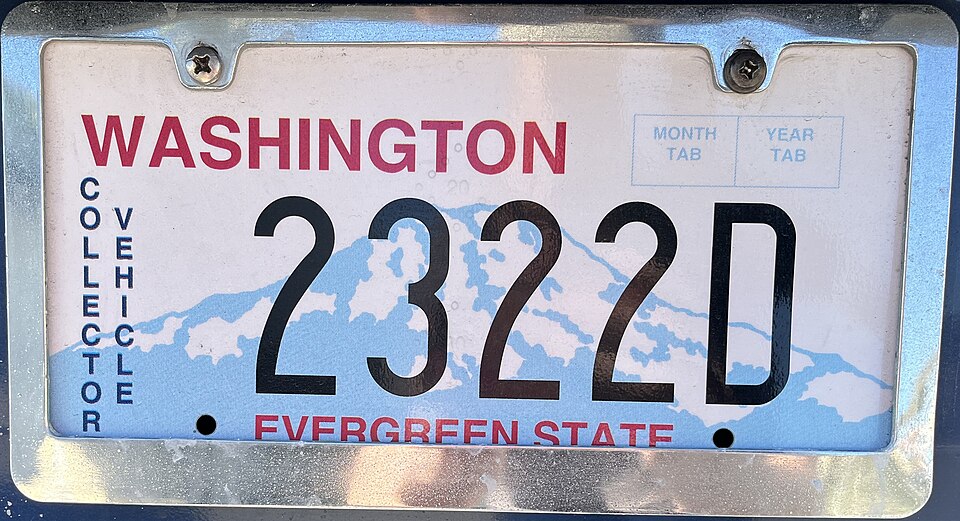
Washington issues collector plates under a specific legal definition. State law defines a “collector vehicle” as any motor vehicle or travel trailer that is at least thirty years old, and a “collector vehicle license plate” as a special plate assigned to a vehicle more than thirty years old (RCW 46.04.126 and RCW 46.04.1261). The plate itself looks like a standard Washington plate with one difference: the words “COLLECTOR VEHICLE” run vertically along the left side, and the serial is black on the standard mountain background. It is a real, state-issued plate — not a decorative tag — and it functions as your vehicle registration.
What counts as 30 years old?
The vehicle’s model year must be at least 30 years behind the current year. In, that means model year 1996 and older qualify. The rule applies to trailers as well as motor vehicles. If your vehicle is close to the cutoff, check the model year rather than the purchase date. A 1997 model does not qualify now even if it was built in late 1996.
Exceptions to the 30-year rule
Washington allows exceptions in limited cases. You must demonstrate to the Department of Licensing’s satisfaction that you have other means of meeting your regular transportation needs, and you file a Collector Vehicle Exception Request along with your plate application. Exceptions are not automatic — they are reviewed case by case.
The new requirements (and why they exist)
Substitute Senate Bill 5127 changed the collector plate program, effective January 15. Some special design plates also carry restricted use, so read the design rules before ordering. The legislature’s stated goal was improving compliance and public safety, because collector plates had become a way for people to avoid full registration on vehicles they were actually driving every day. To get a new collector plate now, you must provide:
- Proof of vehicle ownership — unless the vehicle is already in DOL records.
- A valid registration for a second vehicle used for daily driving, commuting, or business purposes.
- Proof of vehicle insurance — either standard liability coverage or a collector vehicle policy.
The second-vehicle requirement is the one that catches people. It effectively says: a collector plate cannot be your only car. You need a separate, fully registered daily driver in your name.
If you already have collector plates
Existing collector plate holders are grandfathered for the documentation requirement. You do not need to resubmit proof of a second vehicle unless DOL asks. You do still need to carry proof of insurance when driving. If DOL requests information about a collector plate in your possession, you must respond within 45 days. If you do not, the plate can be cancelled.
The same rules apply to restored plates
Vehicles registered with restored plates — original-era plates restored and reused — are subject to the same second-vehicle and insurance requirements. The law did not leave that loophole open.
What you can and cannot do with a collector-plated vehicle
This is the part people underestimate. Display rules differ from the standard front and rear plates requirement, so check what your vehicle must show. A collector plate is not a cheap alternative registration for a car you drive normally. It is a restricted-use registration.
You may drive to and from:
- Auto shows, circuses, parades, and displays
- Special excursions
- Antique car club meetings
- Testing purposes
You may also drive for the pleasure of others without compensation — giving someone a ride for enjoyment, not for hire.
You may not use the vehicle for:
- Regular transportation in the manner of a fully licensed vehicle
- Commercial purposes
- Carrying a load
The allowed uses are narrow, and the prohibited ones are the part that matters in daily practice. Reading both lists together shows what the plate actually permits, rather than what a driver hopes it permits.
Where the restriction applies
That means no commuting, no grocery runs as your normal routine, no hauling for hire, no using the truck to move furniture. Enforcement is not constant, but the restriction is real, and a collector-plated vehicle observed in regular daily use is evidence of a violation.
Why the January documentation exists
The restriction belongs to the registration category itself, not to a sticker or a warning on the plate, so a collector plate does not turn into a general registration just because the vehicle is old enough to qualify for one, and the allowed trips stay limited to shows, parades, club meetings, testing, special excursions, and drives given for the pleasure of others without payment. That is the gap the January documentation was built to close, since a plate with no month or year tabs and no annual tab renewal was being used as cheap registration on cars driven every day, and the second-vehicle, ownership, and insurance requirements now make that pattern visible before a plate is issued, while existing holders keep their plates unless the department asks for documents.
No tabs, so the paperwork carries the weight
With no tab to read, an officer has no visual cue about registration status, so the paperwork on file is what carries that weight, and a Department of Licensing request about a collector plate in your possession has to be answered within 45 days or the plate can be cancelled, and the plate itself stays with the vehicle it was issued for rather than moving to whatever you buy next. Washington does not require month or year tabs on collector plates, which is part of why the program is attractive — but the trade-off is that the vehicle is not registered for general use.
What do Washington collector plates cost?
| Vehicle type | Initial plate fee |
|---|---|
| Passenger vehicle | $105 |
| Truck | $105 |
| Motorcycle | $75 |
These are the plate fees. Your total will also include registration-related charges that vary by vehicle and location, so contact a vehicle licensing office for the exact amount before you mail your application. Compared with a personalized plate — $174 up front plus $52 every year — collector plates are inexpensive up front, and the absence of annual tab fees is a large part of the appeal. The cost is the use restriction, not the money.
Five-year cost comparison
Looking only at plate-specific costs — the part that differs between options, before standard registration, weight fees, and local taxes — the gap is easy to see.
| Plate option | Up-front plate cost | Annual plate fee | Five-year total | Use restrictions |
|---|---|---|---|---|
| Standard plate | $0 extra | $0 extra | $0 | None |
| Specialty design | $162 | $30 | $312 | None |
| Personalized | $174 | $52 | $434 | None |
| Collector vehicle | $105 | No tab renewal required | Same as up front | Significant |
The collector plate wins on price by a wide margin. That is exactly why the state tightened eligibility: the program was never meant to be a cheap registration for a car you drive every day. If you would keep full use of the vehicle, the honest comparison is collector versus standard, not collector versus personalized. Collector saves money only if the restrictions match how you actually use the car.
Collector vs classic vs vintage vs restored vs horseless carriage
Washington does not have separate “classic” and “vintage” plate programs. Those words are informal labels people use in search engines and in conversation. Officially, the state has four relevant categories.
| Category | Vehicle age | What it is | Key requirement |
|---|---|---|---|
| Collector Vehicle | 30+ years | State-issued special plate with “COLLECTOR VEHICLE” on it | Second daily-use vehicle registered, insurance, proof of ownership |
| Restored plates | Same year as vehicle | Original-era Washington plates, restored and re-registered | Must match the vehicle’s model year, original design, no reproductions |
| Horseless Carriage | Built before Jan 1, 1916 | Plate for very early vehicles | Pre-1916 manufacture; new requirements since |
| Standard registration | Any | Normal plate and tabs | Full registration fees, no use restrictions |
Collector vs “classic car plates”
When people search for classic car plates in Washington, they almost always mean collector vehicle plates. There is no separate classic plate. The 30-year rule is the eligibility test, and the collector plate is the product.
Collector vs restored plates
Restored plates are the option for purists. Instead of a new collector plate, you use a genuine set of Washington plates from the vehicle’s model year, restored to their original design. They must not be reproductions. Restored plates can be displayed on both the front and rear, whereas a standard collector plate goes on the rear only. Restored plates now carry the same second-vehicle and insurance requirements as collector plates.
How the restored plate option works, start to finish
- Find a genuine pair from the correct year. The plates must match the vehicle’s model year. A 1965 car needs 1965 Washington plates.
- Confirm they are original, not reproductions. Reproduction plates are not allowed, no matter how accurate they look.
- Restore them to the original design. That means the correct colors, lettering, and finish for that year — not a custom repaint.
- Submit the restored plate application with your registration. The same ownership, insurance, and second-vehicle documentation applies.
- Display them on the front and rear if you are using a matched set, which is the one display advantage restored plates have over a standard collector plate.
Restored plates appeal to owners of older vehicles who want the car to look period-correct. The trade-off is effort: sourcing a usable pair from the right year, restoring them properly, and proving they are authentic.
Custom vehicles and heavily modified cars
Washington separately defines a “custom vehicle” — broadly, a vehicle at least thirty years old and of a model year after 1948, or one built to resemble such a vehicle (RCW 46.04.161). This category exists for modified and replica builds that would not pass as stock collector cars. If your car has been substantially modified — a different engine, chassis work, a replica body — do not assume the collector plate process is the same. Confirm the correct category with a vehicle licensing office before you mail an application, because the documentation and inspection expectations can differ. For most owners of unmodified older cars, collector or restored plates are the right answer. For modified builds, ask first.
Display rules and tabs
- Collector plates are displayed on the rear of the vehicle.
- If you provide a restored set, they may be displayed on the front and rear.
- You do not need to display month or year tabs.
The no-tabs rule is a genuine convenience — no scraping stickers, no expired-tab tickets — but it also removes the visual cue that would tell an officer the registration status, which is part of why the state tightened documentation.
What to do when you sell the vehicle or stop using the plates
If you no longer use the vehicle, you must bring the plates to your local vehicle licensing office. If you no longer own it, complete a Report of Sale to protect yourself from liability for a vehicle that is no longer yours. This is not optional housekeeping. Unreturned plates tied to your name can create liability if the vehicle is later involved in something.
Update Good To Go
If you have a Good To Go! tolling account, update your plate information with the Department of Transportation online or by phone at 866-936-8246. Otherwise tolls may be charged to the wrong account.
Mistakes to avoid with collector plates in Washington
- Applying without a second registered vehicle. Since January 15, this is a hard requirement for new applications.
- Assuming insurance is optional. Liability or collector vehicle coverage is required.
- Using the car as a daily driver. The plate is a restricted-use registration, not a discount registration.
- Buying a 1997 model expecting it to qualify now. The 30-year clock has not reached it yet.
- Using reproduction plates as “restored.” Reproductions are not allowed.
- Forgetting the second-vehicle rule applies to restored plates too. It does.
- Ignoring a DOL information request. You have 45 days to respond or the plate can be cancelled.
- Not returning plates after selling. Return them to a licensing office and file a Report of Sale.
Frequently asked questions
The answers below cover the points drivers ask about most, including the 30-year rule, the January documents, and what the plate allows on the road.
How old does a vehicle have to be for collector plates in Washington?
At least 30 years old, so now that means model year 1996 or older. Trailers qualify under the same rule. Age exceptions can be requested through the Department of Licensing with a Collector Vehicle Exception Request, but they are reviewed case by case and are not automatic.
How much are collector plates in Washington?
The table above lists the fee for each vehicle type. Registration-related charges that vary by vehicle and location are added on top, so contact a vehicle licensing office for your exact total before you mail the application.
Can I use a collector-plated car as my daily driver?
No. The plate is a restricted-use registration, not a discount registration. It may not be used for regular transportation, commercial purposes, or carrying a load, and a collector-plated vehicle observed in regular daily use is evidence of a violation.
Do I need a second car to get collector plates?
Yes, for applications submitted on or after January 15. You must provide a current registration for a second vehicle used for daily driving, commuting, or business purposes, along with proof of ownership and proof of insurance.
Can I use original old Washington plates instead?
Yes, through the restored plate option, which reuses original-era plates. The plates must match the vehicle’s model year, be restored to the original design, and must not be reproductions. Restored plates carry the same insurance and second-vehicle requirements as collector plates.