Washington License Plate cost splits into a one-time issuance fee and a yearly renewal charge. Personalized plates cost for a passenger car or truck, for a trailer, and for a motorcycle. Specialty backgrounds cost , , and . Combining both reaches , , and . Renewal adds , , or each year, charged with your tabs. Standard plates add nothing beyond registration, and the Keep Kids Safe design adds $5. Those figures sit on top of registration and tabs. Collector plates charge once for a car or truck, and for a motorcycle.
Washington License Plate registration totals vary with vehicle weight, county, and regional transit charges, so the plate fee is never the whole bill. A five-year comparison makes the gap clear: standard plates add nothing, specialty plates run $312, personalized plates run $434, and collector plates run $105. Timing matters. Renewing tabs and ordering custom plates together means paying the plate fee once rather than twice. A county licensing office can quote your exact total before you commit to the order.
How to lower your Washington plate cost
Seven moves cut the bill, and most of them cost nothing to try. Two of them save more than the rest combined, and both depend on timing rather than on the plate you choose.
- Renew and apply for the personalized plate at the same time. This is the single biggest saving available. Do both in one transaction and the plate fee is paid once instead of twice. Applying a month before renewal is the most expensive possible timing.
- Pick a standard background if the characters matter more than the design. Personalized on standard is $174 plus $52 a year. Personalized on a specialty background is $214 plus $82 a year. If the design is not the point, save $40 up front and $30 every year.
- Pick a specialty background without personalization if the design is the point. $162 plus $30 a year is the cheapest custom look available.
- Consider collector registration if the vehicle qualifies. $105 once beats $52 or $82 every year, provided the use restrictions fit how you actually drive the car.
- Do not lose your plates. Avoid the replacement fee entirely by mounting the front plate properly and keeping the rear plate clear of tow hitches and bike racks.
- Do not let registration lapse. Late renewal can add penalties that dwarf any plate fee you were trying to avoid.
- Ask about transferring a plate you already own. If you are moving a personalized plate to a new vehicle, confirm the transfer process and whether a new issuance fee applies before you assume either way.
The first item on that list is worth repeating because it is the most frequent avoidable expense in this entire area. The full range sits side by side on the Washington license plates home page. People apply for a personalized plate in March, renew in April, and pay the annual plate fee twice within six weeks. One combined transaction prevents it.
Official sources — Washington State DOL https://dol.wa.gov/vehicles-and-boats/vehicles/license-plates https://dol.wa.gov/vehicles-and-boats/vehicles/license-plates/personalized-plates
Washington license plate cost key facts
| Plate type | Passenger | Truck | Trailer | Motorcycle |
|---|---|---|---|---|
| Standard plate | No extra plate fee | No extra plate fee | No extra plate fee | No extra plate fee |
| Personalized only | $174 | $174 | $122 | $92 |
| Special background only | $162 | $162 | $110 | $80 |
| Personalized + special background | $214 | $214 | $162 | $132 |
| Collector plate | $105 | $105 | Not listed | $75 |
All figures in that table are one-time issuance fees charged in addition to registration. They are not the annual amount. The annual amounts are separate and are covered in the next section.
Annual renewal fees for custom plates
| Plate type | Annual fee on top of registration |
|---|---|
| Personalized (standard background) | $52 |
| Special background | $30 |
| Special background that is personalized | $82 |
This is the part most price guides leave out. A $174 personalized plate is not a $174 purchase. It is $174 plus $52 every year for as long as you keep it. Over a normal ownership period, the renewal fees exceed the issuance fee.
What is included and what costs extra
When you register a vehicle in Washington, the standard plate pair comes with the registration. You are not buying plates as a product. Washington personalized plates carry both an issuance charge and an annual renewal. You are paying registration, and the state hands you plates as part of that transaction. Everything beyond the standard design is an add-on with its own price:
- Choosing your characters adds the personalized fee.
- Choosing a special design background adds the special background fee.
- Doing both adds a combined fee that is less than the two separate fees added together on some vehicle classes and roughly equal on others, which is why the combined column is published separately rather than calculated.
- Certain designs carry an additional surcharge on top of the base special background fee.
The Keep Kids Safe plate is the clearest example of a design-level add-on: it adds $5 to the applicable amount. Confirm with the Department of Licensing whether that $5 lands at issuance, at renewal, or both, since the surcharge structure varies by plate program.
What registration covers that the plate fee does not
Registration is the legal authority to operate the vehicle. It includes the base registration charge, weight-based charges where they apply, county and local fees, regional transit fees in certain areas, and any vehicle-specific charges such as those that apply to electric vehicles. None of that is a plate fee, and none of it goes away if you choose a standard plate. So the honest answer to “how much do plates cost” is: the plate portion is published and predictable, and the registration portion is not. Budget for both separately or you will be short at the counter.
Personalized plates: the real cost over time
A personalized plate on a standard background is the most frequent upgrade, and $174 is the number people remember. The $52 is the number they forget. Five-year math for a passenger vehicle, counting the issuance fee plus four annual renewals:
| Year | Charge | Running total |
|---|---|---|
| Year 1 (issuance) | $174 | $174 |
| Year 2 renewal | $52 | $226 |
| Year 3 renewal | $52 | $278 |
| Year 4 renewal | $52 | $330 |
| Year 5 renewal | $52 | $382 |
That is $382 in plate fees over five years, or about $76 per year averaged out. The renewal fees account for more than half of it. If you hold the vehicle longer, the math keeps tilting toward the renewal side. At ten years, you have paid $174 plus nine renewals, or $642, and the original issuance fee is a small fraction of the total. Washington specialty plates follow a similar structure with a lower annual rate. None of that is an argument against personalized plates. It is an argument for knowing what you are signing up for. A $52 annual charge is easy to absorb; a $52 annual charge you did not expect, arriving on a renewal notice you thought was already high, is the thing that generates complaints.
The truck, trailer, and motorcycle numbers
Personalized fees are not uniform across vehicle classes. A personalized trailer plate is $122 to issue rather than $174. A personalized motorcycle plate is $92. The annual renewal for a personalized plate is $52 regardless of class, which means the smaller vehicles have a proportionally larger annual burden relative to their issuance cost. A personalized motorcycle plate, for example, is $92 up front and $52 a year after that. By year three you have paid more in renewals than you paid to issue the plate.
Specialty plates: cheaper up front, cheaper every year
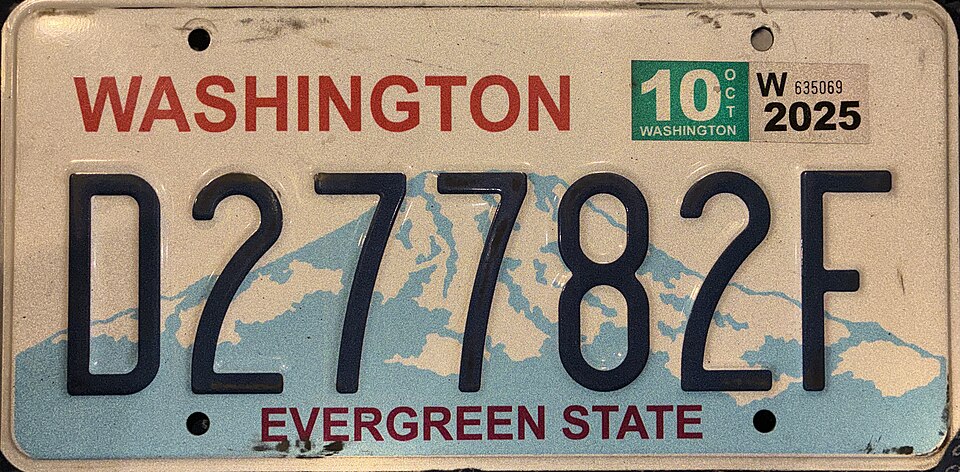
A special background plate without personalization is the least expensive way to get a non-standard look. On a passenger vehicle it is $162 to issue and $30 a year. That is $12 cheaper to start and $22 cheaper per year than a personalized plate. Five-year math: $162 plus four renewals at $30 is $282. Compared with $382 for a personalized plate, that is $100 less over five years. What you give up is character choice. Many specialty designs allow personalization and some do not. If a design cannot be personalized, your plate carries the program’s standard format, which is often a letter prefix plus a number sequence.
Personalized specialty plates
Combining both is the most expensive frequent option: $214 to issue and $82 a year on a passenger vehicle. Five-year math is $214 plus four renewals at $82, or $542. The $82 annual fee is the number that catches people. It is not $52 plus $30. It is its own published rate, and it is the highest recurring plate charge in the table. If you are choosing between a personalized standard plate and a personalized specialty plate, the difference is $40 up front and $30 every year after that.
Collector plates: a different cost structure entirely
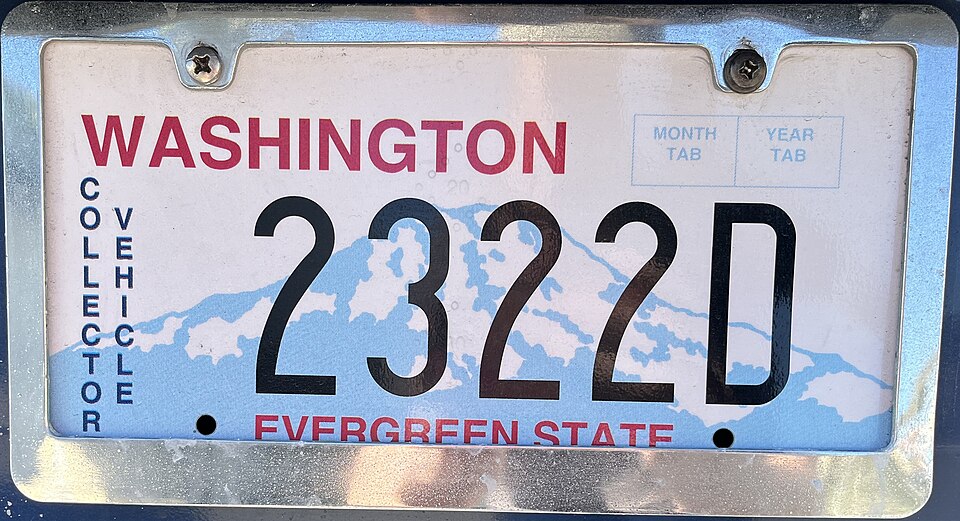
A collector plate is $105 for a passenger vehicle or truck and $75 for a motorcycle. It is not a cosmetic upgrade. It is a registration category for qualifying older vehicles, and it comes with real use restrictions. That $105 is a one-time plate charge rather than an annual plate fee, which makes it the cheapest long-run option in this guide for a vehicle that qualifies. Over five years it is $105 total in plate fees, against $382 for a personalized plate and $282 for a specialty plate. Washington collector plates are the cheapest long-run option for a qualifying vehicle. The tradeoff is eligibility and use. Collector registration is limited to vehicles that meet the age requirement, and the vehicle cannot be used for regular transportation, commercial purposes, or carrying a load. You also need to meet the ownership and insurance conditions, including proof of another vehicle for daily use. The Department of Licensing covers the eligibility rules. If the vehicle is your only car, collector plates are not an option no matter how much you like the price.
Why registration costs more than the plate table suggests
The plate fees above are fixed. Registration is not. Two people with the same plate type can pay very different totals, and it is not an error.
| Factor | Why it changes the total |
|---|---|
| Vehicle type | Passenger cars, trucks, trailers, motorcycles, and motor homes are assessed differently |
| Weight | Trucks and heavier vehicles pay weight-based charges |
| County | Counties add their own fees, and the amounts differ |
| Regional transit | Certain areas add a transit fee to registrations |
| Local levies | Cities and transportation benefit districts may add charges |
| Vehicle-specific charges | Electric and plug-in vehicles may carry additional charges |
| Transaction type | A purchase includes use tax on the price paid |
This is why the only accurate estimate comes from the office that will process your transaction. Give them your VIN and your address, and they can produce a real number. Give them a plate type and a vehicle model, and they can only give you a range. If the registration side is the part you are unsure about, the documents and deadlines are covered in our start to finish registration walkthrough.
Hidden costs people forget
Sticker price is only part of the bill. Three charges show up later: the yearly renewal, replacement costs when a plate is damaged or stolen, and registration fees that run on their own cycle. Each one is small alone and adds up over the years you keep the plate.
The annual renewal
This is the big one, and it is covered above. Every personalized and specialty plate carries an annual fee. It does not expire after a few years or get absorbed into registration.
Replacement plates
If a plate is lost, stolen, or damaged beyond legibility, you need a replacement, and replacements carry their own fee. The amount varies by plate type. Confirm the current replacement charge with the Department of Licensing rather than budgeting from an old figure. Damaged plates are more frequent than people expect. A front plate on a low bumper takes a beating from parking blocks and road debris. A bent or delaminated plate can be rejected as illegible.
Paying the issuance fee twice
If you apply for a personalized plate and then renew your registration shortly after, you can end up paying the plate fee in both transactions. The fix is simple and covered in the next section.
The wait
Personalized plates take 8 to 10 weeks to be made and mailed. That is not a fee, but it is a cost in the sense that you may need a temporary permit or you may be driving with standard plates for two months after paying for custom ones. Plan the timing around a renewal rather than a road trip.
Duplicate plates for a second vehicle
Each vehicle needs its own registration and its own plate fees. You cannot buy one personalized plate and move it between two cars. Keep the receipt from the licensing office. It is the only record that separates the plate fee from the registration charges if you need to query a total later.
Worked examples
Three short examples show how the charges stack for a realistic vehicle. The arithmetic is written out so you can follow each step and substitute your own numbers.
Personalized plate on a used sedan
A driver buys a used sedan privately and wants their own characters on a standard background. They renew their registration and apply for the plate in the same visit.
- Standard registration fees: varies, paid once
- Personalized plate issuance: $174
- Annual renewal, year 1: $52 (combined with the registration renewal)
- Four more years of renewals: 4 x $52 = $208
- Five-year plate cost: $174 + $52 + $208 = $434
If they had applied three months before renewal instead of combining it, they would have paid $52 twice in the first year, pushing the total to $486. Same plate, $52 more, purely from timing.
Specialty plate on a truck
A truck changes the numbers, but not the structure of the bill. The same two charges apply, and the annual one still follows the plate for as long as it stays registered.
- Special background issuance: $162
- Annual renewal: $30
- Four renewals: 4 x $30 = $120
- Five-year plate cost: $162 + $120 = $282
Same truck, same five years, $152 less than the personalized example above.
Keep Kids Safe plate with personalization
- Personalized plus special background: $214
- Keep Kids Safe surcharge: $5
- Issuance total: $219
- Annual renewal: $82 (confirm whether the $5 surcharge also applies at renewal)
- Four renewals: 4 x $82 = $328
- Five-year plate cost: $219 + $328 = $547, plus any renewal surcharge
This is the most expensive frequent combination. It is also the one where the annual fee most often surprises people, because $82 is not an obvious sum of the $52 and $30 figures they saw quoted separately.
Bonus: collector plate on a qualifying 1980s truck
- Collector plate, passenger or truck: $105
- Annual plate fee: none listed
- Five-year plate cost: $105
Lowest plate cost in the guide by a wide margin, and only available if the vehicle meets the age and use requirements.
Five-year cost comparison
Five years is long enough to show the difference between a one-time charge and a recurring one. The table keeps the comparison on plate fees alone, so registration does not distort it.
| Option | Issuance | Annual | Five-year total |
|---|---|---|---|
| Standard plate | $0 extra | $0 extra | $0 extra |
| Specialty (special background) | $162 | $30 | $282 |
| Personalized | $174 | $52 | $382 |
| Personalized + specialty | $214 | $82 | $542 |
| Collector | $105 | None listed | $105 |
Read the table as a spread rather than a ranking. Over five years, the gap between a standard plate and the most expensive combination is $542 in plate fees alone. The gap between standard and a plain specialty plate is $282. That is the real decision: not whether $174 sounds reasonable, but whether $52 a year for as long as you own the car is worth it to you.
Frequently asked questions
The questions below cover the figures on this page, the renewal side, and the reasons a total can come out higher than the sticker figure suggests.
How much does a personalized plate cost in Washington?
The issuance fee for a passenger vehicle or truck is $174, with a $52 renewal every year. Trailer and motorcycle amounts are lower. All of it is paid on top of registration.
Is there an annual fee for Washington specialty plates?
Yes. A special background plate renews at the annual rate shown in the table above, and personalizing it raises that rate. Both renew with your tabs and are charged on top of registration.
Do standard Washington plates cost extra?
No. Standard plates carry no extra plate fee beyond your normal registration. You still pay registration, weight charges, county fees, and any local transit charges that apply to your address.
How much is a collector plate?
A collector plate is a one-time charge, lower than any custom option. The amounts by vehicle type are in the table above, and the vehicle must still meet collector eligibility and use rules.
Why did my total cost more than the plate fee?
Because registration is calculated separately. Vehicle type, weight, county, regional transit, local levies, and vehicle-specific charges all affect it. The plate fee is only one line on the final receipt.