Washington License Plate format uses three letters followed by four numbers, a pattern in place since July 1998. The aluminum measures 12 by 6 inches and weighs a pound. Washington sits across the top, Evergreen State along the bottom, and Mount Rainier fills the background. Characters read left to right. Motorcycle plates run smaller. Specialty and collector issues add their own prefixes. Personalized plates break the pattern with one to seven characters, subject to state rules on language and reserved series.
Washington License Plate numbers advance in series. Each block of combinations gets used up over time, and the leading letter changes as the state moves forward. That pattern covers why many plates issued in the same period share a first letter. The letter carries no county or regional meaning today. Older Washington plates used county codes, a system the state abandoned. Reading a plate back to an agency means watching letters that look like numbers, such as I and 1, O and 0.
How to read a Washington plate correctly
Character confusion is not a small issue. It causes misread tolls, failed insurance lookups, and parking tickets issued to the wrong vehicle. The problem is structural: Washington’s format mixes letters and numbers, and several characters are near-twins in many typefaces.
The classic confusions
| Confusion | How to tell them apart |
|---|---|
| Letter L vs. digit 1 | 1 is usually a plain vertical stroke; L has a horizontal foot at the bottom |
| Letter O vs. digit 0 | 0 is typically narrower and more oval; O is wider and rounder |
| Letter I vs. digit 1 | Position helps: in a standard plate the first three characters are letters, so position 1–3 is a letter |
| Letter S vs. digit 5 | 5 has a flat top bar and a curve; S is a continuous curve |
| Letter Z vs. digit 2 | 2 has a flat base; Z has flat top and bottom with a diagonal |
| Letter B vs. digit 8 | 8 is closed on both loops; B has a straight left spine |
| Letter G vs. digit 6 | 6 is a single closed lower loop; G has an open right side |
Use position as your first tool
The single most useful trick is positional. On a standard Washington passenger plate, characters 1 through 3 are letters and characters 4 through 7 are numbers. So if you are unsure whether the third character is an I or a 1, position tells you it is a letter. If you are unsure whether the fifth character is an O or a 0, position tells you it is a number. This does not help on personalized plates, where letters and numbers can be mixed freely. On those, slow down and read character by character instead of trying to pattern-match the whole string.
Read it the way a system will
When you are writing your plate number on a form — insurance, tolling, parking, a lease — write it exactly as it appears, without spaces, in capitals. Do not “correct” what looks like an error. Do not add a dash for readability. If your plate reads ABC1234, write ABC1234. If you are providing a plate number to a tolling system and you also have a Good To Go! account, remember to update the plate on the account when your plate changes. An outdated plate on a tolling account is one of the most frequent causes of unexpected toll notices.
Official sources — Washington State DOL https://dol.wa.gov/vehicles-and-boats/vehicles/license-plates https://app.leg.wa.gov/rcw/default.aspx?cite=46.16A.200
Washington License Plate Format Key Facts
| Question | Answer |
|---|---|
| Standard passenger format | Three letters, then four numbers (ABC1234) |
| When it started | July 1998, with the current standard plate design |
| Plate material and size | Aluminum, 12 inches by 6 inches; motorcycle plates are smaller |
| Text on the standard design | “Washington” at the top, “Evergreen State” at the bottom |
| Background | Mount Rainier |
| Do letters mean a county? | No. County codes are not used on current standard plates |
| Why do many plates share a leading letter? | Plates are issued in series, so nearby issues share prefixes |
| Personalized length | 1–7 characters, with many patterns blocked |
| Personalized allowed characters | Letters, numbers, spaces, and dashes |
| Collector and specialty formats | Set by each issuing program, with their own prefixes |
The Format Covered, Piece by Piece
A standard Washington passenger plate carries seven characters: three letters followed by four digits. Written without spaces, that is ABC1234. The format is fixed in structure even though the specific characters keep changing, because the state has to keep issuing unique combinations to a growing fleet of vehicles. Two things follow from that structure, and they are worth separating clearly:
- The structure is stable. Three letters, four numbers, in that order. A plate that does not match that pattern is either a personalized plate, a specialty plate, a collector plate, or a non-passenger class with its own rules.
- The content is not stable. Any specific combination like ABC1234 is just one point in a long sequence. It was issued at some moment, and the sequence has moved on since.
Washington has used different formats over its history, and older plates still turn up at car shows, in barns, and on collector vehicles. Those historical plates had their own conventions, including county coding. Washington personalized plates use a different character layout from the standard serial. The current standard format is a much simpler idea: a sequence, a design, and no local meaning baked into the characters. If you want the broader picture of how designs and formats have changed over the decades, see the Department of Licensing site. If you are trying to identify a specific plate in front of you, the Department of Licensing walks through that process properly.
Anatomy of a Washington Plate
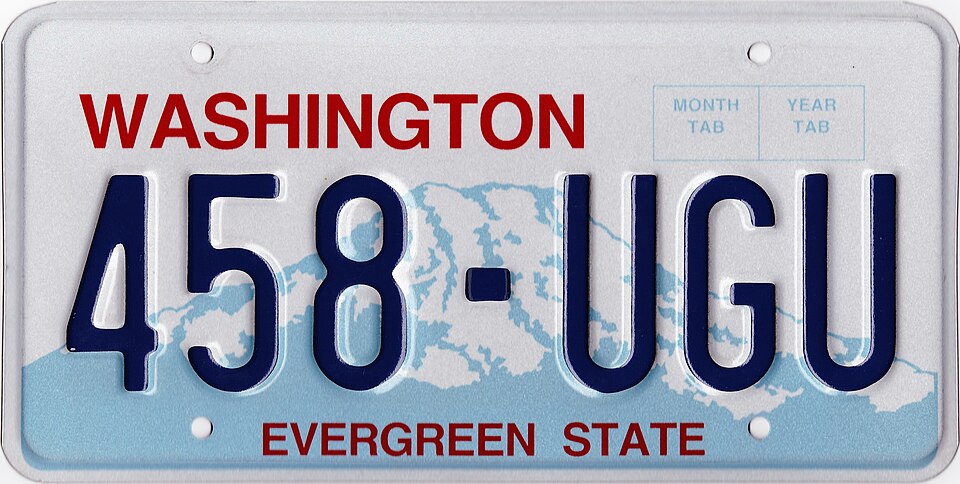
Think of the standard plate as a set of parts. Each part does a different job, and only one of them is the actual registration identifier.
The state name at the top
The word “Washington” appears across the top of the standard design. This is identification, not data. It tells you the jurisdiction that issued the plate. It does not change, it does not encode anything, and it is not part of the registration number.
The state nickname at the bottom
The nickname sits along the bottom edge, centred, in a smaller face than the state name. It is the part of the design most often lost in a photograph and most useful when identifying a plate at a distance.
The graphic background
The standard background is Mount Rainier. The artwork sits behind the characters and is designed to stay legible without interfering with reading the plate number. Washington specialty plates add their own prefix or label without changing the base format. When you are reading a plate — especially at an angle, in rain, or at night — the mountain graphic is visual noise, which is exactly why plates are designed with contrast and embossing.
The registration characters
This is the part that matters. Central to the plate, in large characters, sits the three-letter, four-number combination. This is the registration identifier for that vehicle. It is what a toll system reads, what a parking enforcement officer writes down, and what you give to your insurer.
Registration tabs
The month and year tabs on the rear plate show when the registration expires. These are separate physical stickers applied to the plate, not part of the printed design, and they change every renewal cycle. The renewal process and the tab rules are covered on the Department of Licensing site.
The physical plate itself
The plate is aluminum, 12 inches by 6 inches, with motorcycle plates made smaller. That size is standardized so that plates fit mounts, frames, and readers across the country. The metal matters practically: aluminum plates can bend, and a bent plate can make characters harder to read or cause a reader to misread them.
Why So Many Washington Plates Start With the Same Letter
Two questions come up whenever a driver notices the same leading letter again and again: whether the letter means something, and why the pattern shifts over time. Both have a short answer.
The short answer
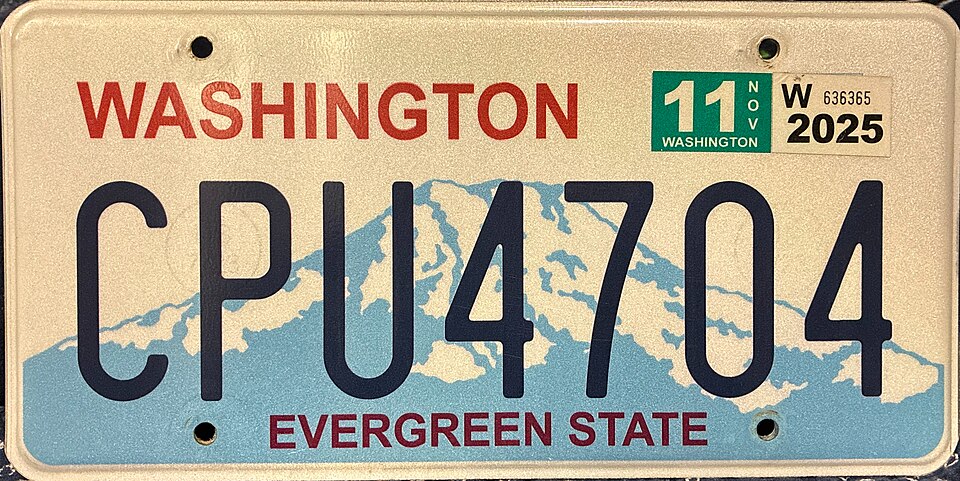
This is the question that generates the most confusion, so it deserves a direct answer. Washington issues plates in series, and the state advances through the alphabet and the number sequence over time. Because issuance is sequential, plates issued around the same period tend to share the same leading letter. If a large block of combinations beginning with a particular letter is being issued during a stretch of months, most new plates you see during those months will begin with that letter. That is the entire description.
It is a series, not a code
It is a serial progression. It is not a regional code, not a county code, not a city code, and not a vehicle-type code. When a series is used up, the leading letter changes, and the plates on the road gradually shift to the next block.
What the letter does tell you
This produces a very recognizable real-world pattern. Drivers notice clusters of plates starting with, say, C, and reasonably wonder whether C means something. A Washington plate lookup needs the characters read correctly, which is why position matters. It does not mean C is a place code. It means C-prefixed combinations were the ones being issued at that time. Two cars with C-prefixed plates are not necessarily from the same place, registered in the same year, or owned by people with anything shared. They simply drew from the same block of the sequence.
The mix you see on the road
Because plates stay on vehicles for years, the road fleet is a mix of many series at once. New issuance may be concentrated in one leading letter, while older vehicles carry earlier blocks. Over time the distribution flattens out as plates cycle off vehicles. What you see in a parking lot is a snapshot of several years of issuance layered together.
A caution about letter-to-era tables
Do not try to build a letter-to-era table. You will find plenty of internet speculation about which letters map to which years, and most of it is unreliable. The state does not publish a simple public letter-to-year chart, and the sequence does not advance on a neat calendar schedule. If the exact issue date of a plate matters for your purposes, confirm with the Department of Licensing rather than trusting a chart.
What the Letters and Numbers Mean — and What They Don’t
Here is the cleanest way to think about it. What they mean: the combination is a unique identifier assigned to a specific vehicle registration. It distinguishes that vehicle from every other vehicle with a standard plate. What they do not mean: almost everything else people assume. They do not encode:
- The county or city where the vehicle is registered
- The owner’s address, initials, or name
- The vehicle’s make, model, weight class, or year
- The registration expiration date
- The driver’s license status of anyone in the vehicle
The expiration date lives on the tabs, not in the characters. The vehicle class lives in the registration record, not on the plate face. The county is in the record, not the number. This is a deliberate design choice. Encoding location into plate numbers creates real problems: plates become harder to administer when boundaries change, and the number of available combinations gets consumed by rules that serve no safety or revenue purpose. Washington’s current approach treats the plate number as a pure unique key. There is a practical benefit for drivers too. A plate number that carries no location information is a plate number you can move with you when you relocate within the state, without any implication that the characters are now “wrong.” Your address on file changes; your plate number does not have to.
County Codes: Then vs. Now
This is where a lot of confusion originates, because it is genuinely true that Washington plates once carried county information. Older historical Washington plates used county codes. That system was abandoned. If you have seen an old plate with a numerical or letter prefix that seemed to correspond to a county, you were probably looking at exactly that legacy system — and it is not how current standard plates work. The distinction matters in three situations:
- Reading a plate on the road today. County codes are irrelevant. A current standard plate tells you nothing about county.
- Identifying a collector plate. Historical plates with county codes are period artifacts. They belong in the collector plate conversation, not the daily-driving conversation.
- Buying a novelty “county” plate. Anything sold as encoding your county is decorative at best. It is not a state-issued registration plate.
If you need to know the county associated with a vehicle, that information comes from the registration record, not from the plate.
Personalized Plates Have a Completely Different Format
Personalized plates are the one place where the characters do mean something — because a human chose them. That is the whole point, and it is also why the rules around them are stricter than people expect. A personalized plate can be 1 to 7 characters and may use letters, numbers, spaces, and dashes. Seven characters happens to match the length of ABC1234, which creates an obvious collision problem: someone could request a combination that looks exactly like a standard plate, and then two different vehicles would appear to share a plate number. Washington handles that by blocking many patterns, including combinations that resemble the standard series — for example, three letters followed by four numbers. The blocking is not a judgment about the request; it is a technical safeguard against duplicates and against confusing one plate with another. That means a request can be perfectly innocent, correctly formatted, and still be refused. If you are planning a personalized plate, read the full rules before you fall in love with a combination: the Department of Licensing. The page covers character rules, blocked patterns, and the annual fee structure, which differs from standard registration. Two short framing points:
- Personalized plates are not a separate registration. They replace the plate on your vehicle while your registration continues. The fees are additional and annual.
- A blocked pattern is not appealable on taste grounds. The rule exists to protect plate uniqueness, so arguing that your combination is meaningful will not typically change the outcome. Have a second and third choice ready.
Collector and Specialty Plate Formats
Collector plates and specialty plates have their own prefixes or formats set by the issuing program. This is the third format family, alongside standard and personalized, and it behaves differently from both. Because each program defines its own format, there is no single rule you can apply across all of them. A specialty plate may carry a program identifier, a distinct background, or a character pattern that marks it as belonging to that program. A collector plate may follow yet another convention. The reliable approach is to treat the plate in front of you as belonging to a program and then check that program’s rules.
- For program background plates and how they are issued, see the Department of Licensing site.
- For collector vehicle plates and their distinct tab rules, see the Department of Licensing site.
One practical note that catches people out: collector vehicle plates do not require month/year tabs. If you are reading a collector plate and looking for tabs that are not there, that absence is normal and is not evidence of an expired registration.
Mistakes People Make With Plate Formats
- Assuming the leading letter means a region. It does not. It reflects the serial block being issued at the time.
- Assuming a newer-looking plate means a newer car. Plates get replaced. A new plate on an old car is routine.
- Assuming the plate tells you the expiration. The tabs do. And on collector plates, there are no tabs at all.
- Substituting characters to “fix” a plate number. If a record will not match, the usual cause is a character confusion, not a wrong plate.
- Requesting a personalized plate that mirrors the standard pattern. It will be blocked, and you will have lost time.
- Trusting an internet letter-to-year chart. Confirm with the Department of Licensing if the date matters.
How the Format Affects Everyday Tasks
Reading a plate correctly is not an academic exercise. It changes how you handle a sale, a toll notice, an insurance quote, and a lost plate report, and each case rewards the same habit.
Buying or selling a vehicle
When you buy a vehicle, the plate situation depends on the transaction and the plate type. Standard plates generally stay with the vehicle in Washington’s system, while personalized plates are tied to the holder. This is one of the reasons personalized plates have their own renewal rules and deadlines. See the Department of Licensing for the sequence of stages.
Reporting a lost or stolen plate
A missing plate is a replacement issue, not a renewal issue. The two processes are separate, and mixing them up wastes a trip. See the Department of Licensing.
Paying tolls
Toll systems read your plate characters. If your plate is bent, obscured by a frame, or dirty, the read can fail or return the wrong combination. Keep the plate flat and legible, and keep your tolling account current.
Insuring a vehicle
Insurers key on the plate number. A single transposed character can produce a mismatch that takes a phone call to resolve. Read your plate in good light and check it against your registration document before you type it.
Frequently Asked Questions
The questions below cover the serial pattern, the leading letter, and the difference between a standard and a personalized layout. Each answer is short and points to the section that carries the detail.
What is the standard Washington license plate format?
Three letters followed by four numbers, as in ABC1234. Washington adopted that layout with the current standard plate design in July 1998, and it remains the standard passenger format today.
Do Washington plate letters indicate the county?
No. Current standard plates do not encode the county in the number. Older historical plates did use county codes, but Washington abandoned that system, so the characters tell you nothing about where the vehicle is registered.
Why do I keep seeing plates that start with the same letter?
Because plates are issued in series. The state works through the alphabet and number sequence over time, so plates issued around the same period share a leading letter. It is not a regional code.
How many characters can a personalized Washington plate have?
One to seven characters, using letters, numbers, spaces, and dashes. Many patterns are blocked, including combinations that look like the standard three-letter, four-number series, so always have backup choices ready.
Is the letter O ever a zero on a Washington plate?
On standard plates, position settles it. The first three characters are letters and the last four are numbers, so an O-shaped character in the first three positions is a letter. Personalized plates can mix both, so read those carefully.